
What Is Agile Software Development? Principles, Process & Examples
Agile software development is a way of building software that embraces change instead of fighting it. Rather than betting everything on one big “final release, “ Agile teams deliver in small increments, learn from real user feedback, and adjust priorities as they go.
If you’re a founder, product manager, or business owner, this matters because software projects rarely fail due to a lack of effort. They fail due to mismatched expectations, late discoveries, and rigid plans that don’t survive contact with the market. Agile addresses those risks with short delivery cycles, tight collaboration, and continuous improvement.
In this guide, you’ll learn what Agile is (and what it isn’t), how the Agile Manifesto shapes day-to-day work, what an Agile software development process looks like in practice, and how Agile compares to Scrum, Kanban, and Waterfall. By the end, you’ll be able to decide whether Agile fits your product, and how to implement it without the common mistakes.
Quick take
Agile is a mindset guided by values and principles. Scrum, Kanban, and XP are frameworks and practices that apply that mindset.
What is agile software development? (definition + mindset)
Agile software development is an umbrella term for approaches to building software based on the values and principles of the Agile Manifesto. At its core, Agile is a mindset: deliver value early, learn fast, collaborate closely, and adapt continuously.
That’s why Agile is often described as iterative and incremental:
- Incremental means you ship the product in small pieces (features) instead of all at once.
- Iterative means you learn from each delivery and refine what you build next (and sometimes revise what you already built).
Agile is commonly implemented through frameworks like Scrum or Kanban, but it’s important to separate the terms:
- Agile = the philosophy (values + principles).
- Scrum / Kanban / XP = ways to apply Agile in day-to-day work.
If you want the broader context of where Agile fits among SDLC models, see our guide on the main types of software development.
Why Agile software development matters (benefits for product teams)
Agile became popular because it tackles a basic reality: requirements change. Markets shift, competitors ship, and users react in unexpected ways. Agile doesn’t pretend you can fully predict the future, so it optimizes for learning and delivery.
- Faster time-to-value: Stakeholders see working software early and often, reducing the risk of “big bang” failure.
- Better product-market fit: Frequent demos, analytics, and user feedback align teams to real user needs.
- Reduced delivery risk: Smaller increments surface scope, quality, and blockers when they’re cheaper to fix.
- More predictable cadence: Mature Agile teams become consistent in throughput and delivery rhythm.
- Higher team ownership: Cross-functional collaboration and continuous improvement raise engagement.
If you’re planning to measure delivery success, pair Agile with clear KPIs like lead time, deployment frequency, cycle time, and defect escape rate. Start here: the best KPIs for software development teams.
Agile Manifesto: 4 values and 12 principles (agile principles)
The Agile Manifesto is famous for four core values. They’re easy to quote, but the real value is using them to make trade-offs during planning and delivery.
The 4 values (in plain English)
-
Individuals and interactions over processes and tools
Tools matter, but communication and teamwork matter more, especially when requirements are unclear. -
Working software over comprehensive documentation
Documentation is helpful when it reduces risk. But “perfect docs” don’t replace a working product. -
Customer collaboration over contract negotiation
Agile expects ongoing alignment, not a one-time handoff of requirements. -
Responding to change over following a plan
Plans are useful; rigid plans are dangerous. Agile keeps planning continuous.
The 12 principles (what teams actually practice)
The principles operationalize those values. In practice, they translate into habits like:
- Shipping frequently (weeks, not quarters)
- Welcoming change (even late) when it improves outcomes
- Maintaining sustainable pace
- Treating quality and technical excellence as non-negotiable
- Regularly reflecting and improving (retrospectives)
Rituals ≠ results
If a team is “doing Scrum ceremonies” but can’t ship working software frequently, they’re adopting the rituals without the principles.
Agile software development process: lifecycle, roles, ceremonies, and artifacts
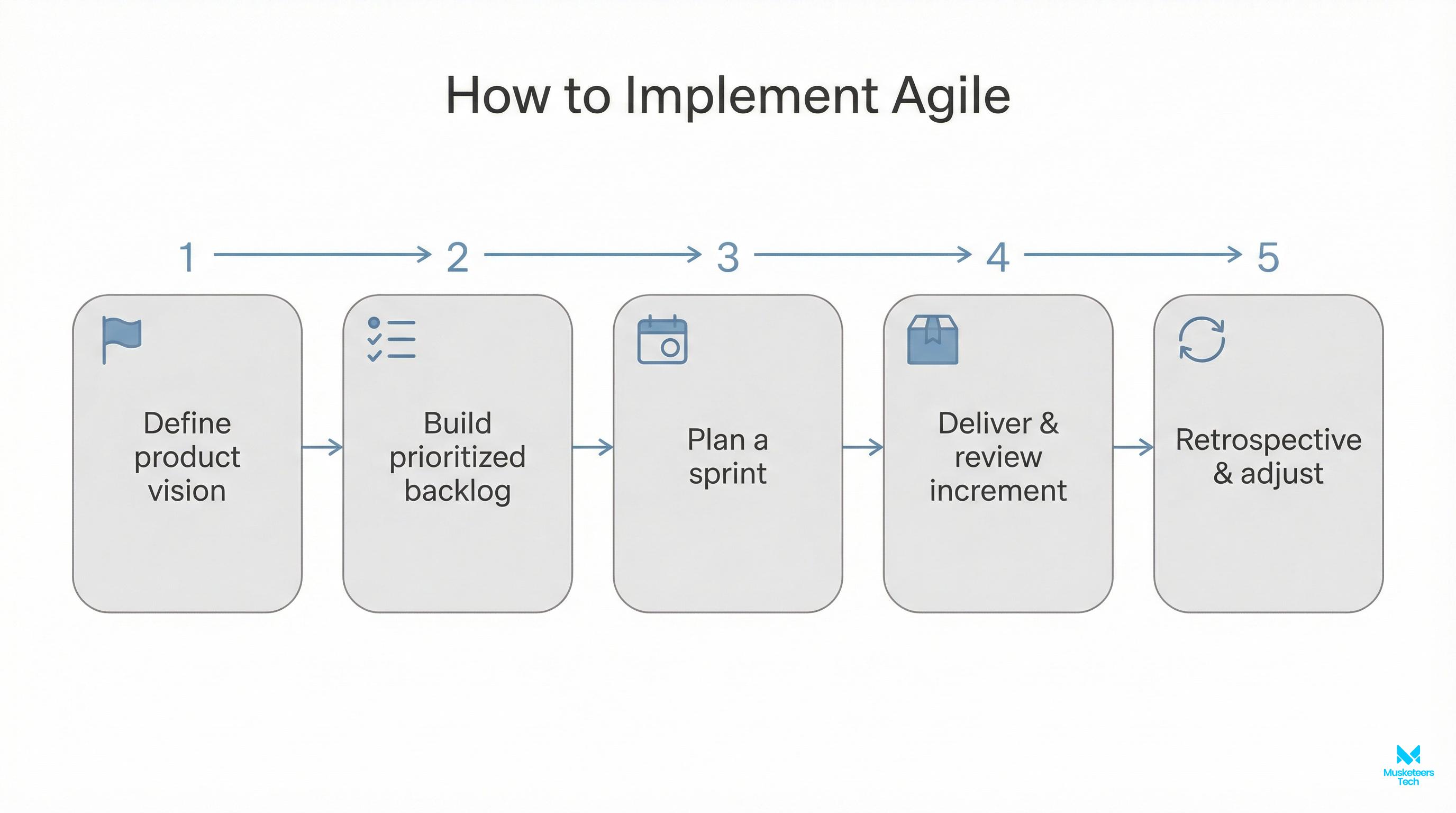
There isn’t one universal “Agile SDLC,” but most Agile teams follow a repeating loop:
- Discover and prioritize what delivers the most value (backlog)
- Plan a short timebox of work (iteration/sprint)
- Build and test continuously (quality built-in)
- Demo working software to stakeholders/users
- Learn and improve (retrospective + backlog refinement)
Agile roles (who does what)
Even outside Scrum, most Agile delivery needs clear accountability:
- Product Owner / Product Manager: owns outcomes, prioritization, and clarity of “what good looks like.”
- Delivery Lead / Scrum Master: improves flow, removes blockers, keeps the system healthy.
- Developers (cross-functional team): build, test, and ship, ideally without heavy handoffs.
A common failure mode is unclear ownership: no one is truly accountable for priority decisions, so the team churns.
Agile ceremonies (rhythm that creates alignment)
Typical ceremonies (names vary by framework):
- Sprint/Iteration planning: choose what to deliver next and define a realistic goal.
- Daily standup: short coordination to surface blockers.
- Review/Demo: show working software; confirm whether it meets the need.
- Retrospective: improve how you work (process, tooling, collaboration).
Good Agile ceremonies produce decisions and clarity. Bad ceremonies produce meetings.
Agile artifacts (how work is made visible)
Core artifacts include:
- Product backlog: prioritized list of outcomes/features.
- Sprint backlog / iteration plan: the subset you commit to deliver in the timebox.
- Definition of Done (DoD): shared quality standard (e.g., tested, reviewed, deployed).
- Increment: the working software produced each iteration.
If you want a metrics-first view of delivery health, see essential KPIs for development teams in project management.
Agile vs Waterfall vs Scrum (with a simple comparison table)
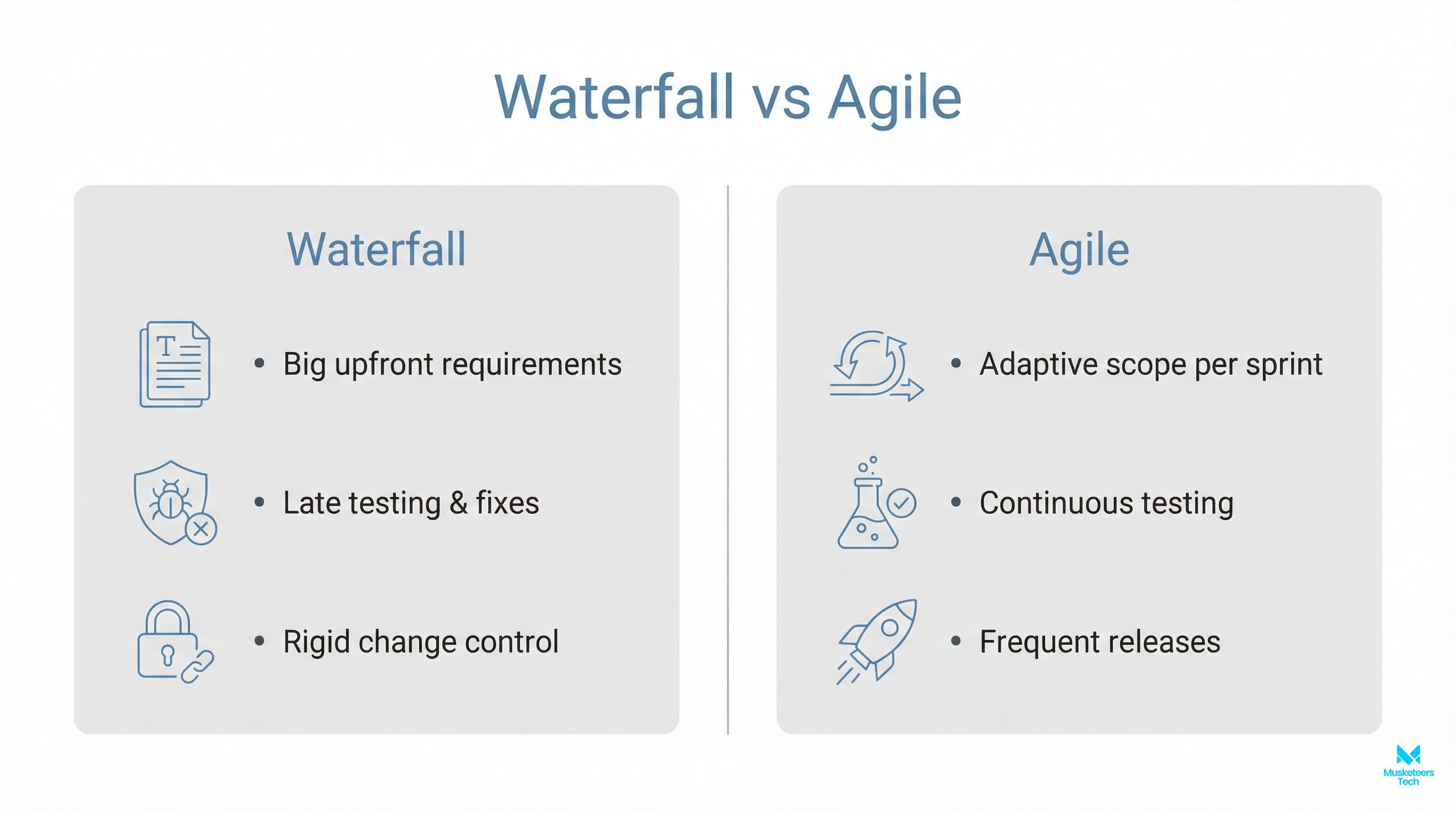
This is one of the most confusing areas on the internet: people compare Agile to Scrum, even though Scrum is a way to implement Agile. A clearer comparison is:
- Waterfall: a plan-driven delivery model
- Agile: a value/principle-driven mindset
- Scrum: a framework that implements Agile with sprints and defined roles/events
Here’s a practical table you can use in stakeholder conversations:
| Dimension | Waterfall | Agile (mindset) | Scrum (Agile framework) |
|---|---|---|---|
| Planning style | Up-front, sequential phases | Continuous planning and reprioritization | Sprint-based planning with a backlog |
| Best for | Stable requirements, regulated docs, predictable scope | Uncertainty, evolving products, fast feedback | Product teams needing a clear operating system |
| Delivery cadence | Big releases, late validation | Frequent increments, early validation | Working increment every sprint |
| Change handling | Formal change control, often expensive | Expected and embraced | Change goes into backlog; sprint scope protected |
| Success measure | On-time/on-scope | Value delivered + learning + quality | Sprint goals + value outcomes |
When Agile may be the wrong choice
If your scope is fixed, compliance demands heavy documentation, and change is minimal, a plan-driven approach (or a hybrid) can be more efficient. Agile shines when learning and adaptation are strategic advantages.
Popular Agile methodologies (Scrum, Kanban, XP)
Scrum is built around timeboxed sprints (often 1–2 weeks), specific roles (Product Owner, Scrum Master, Developers), and recurring events (planning, daily scrum, review, retrospective). It’s strong when you need a predictable cadence and clear accountability.
Best practices & common mistakes (what actually makes Agile work)
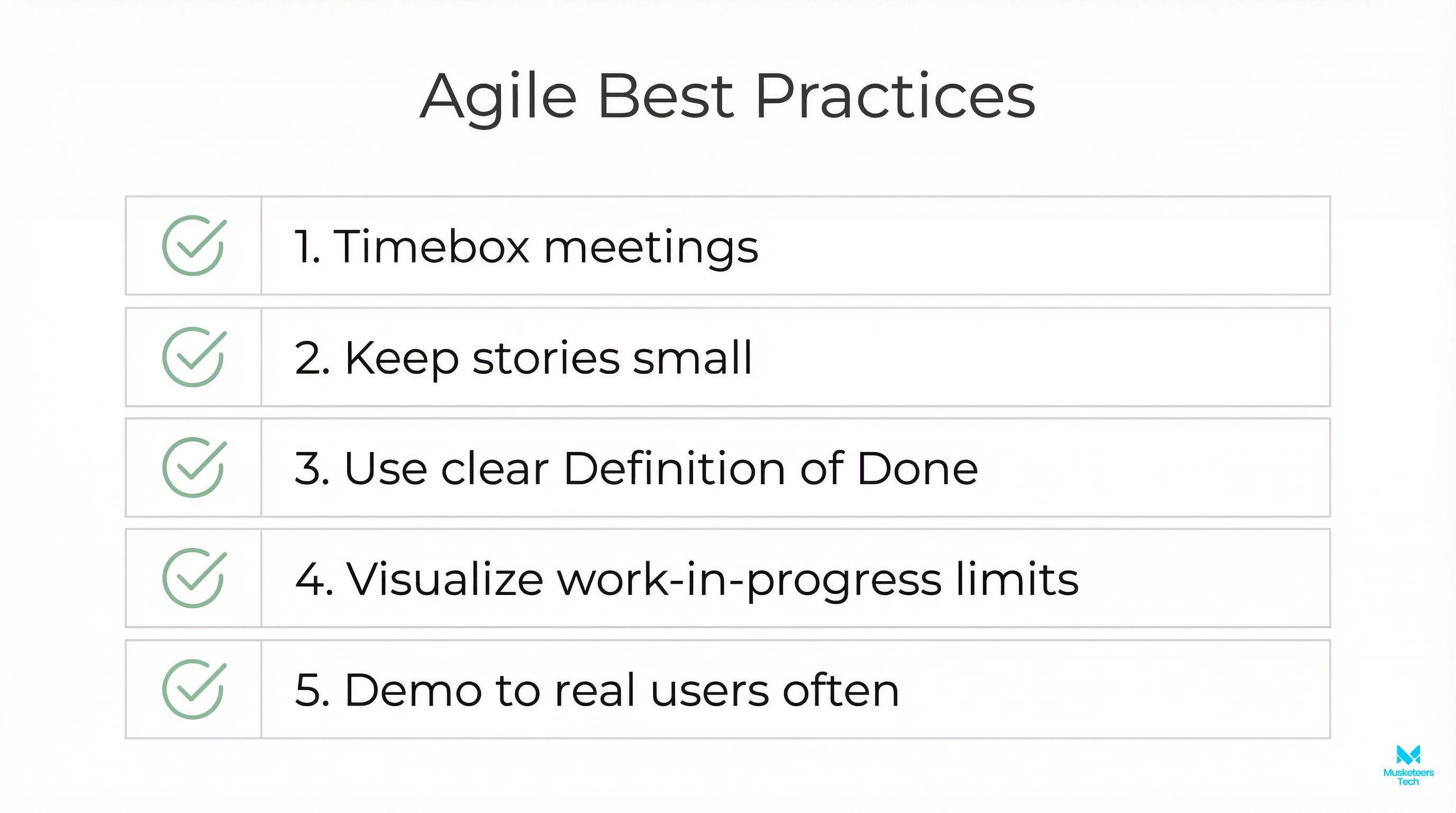
Best practices
- Define “done” clearly: Without a DoD, teams ship “almost done” work that creates hidden costs later.
- Keep iterations small enough to finish: Slice by user value (thin vertical slices), not by technical layers.
- Make feedback real: Bring decision-makers and users to reviews; a demo without them is theater.
- Invest in engineering excellence: Automated testing, CI/CD, code reviews, and observability make frequent shipping safe.
- Measure flow, not just effort: Track cycle time, lead time, throughput, defect escape rate, and reliability.
Common mistakes
- Treating Agile as “no planning” (it’s continuous planning)
- Using Agile as an excuse for scope creep (backlog changes are fine; sprint thrash is not)
- Ignoring technical debt until delivery slows to a crawl
- Overloading teams with parallel work (WIP explosion kills flow)
- Copy-pasting a framework without adapting it to your product context
Tools & platforms for Agile delivery
Agile tools don’t create agility, but they help teams coordinate at scale:
- Jira / Linear / Trello for backlog management and sprint tracking
- Azure DevOps for integrated boards + repos + pipelines (common in enterprise)
- GitHub / GitLab for code collaboration and CI/CD
- Slack / Microsoft Teams for lightweight, async coordination
- Feature flags + analytics to validate value quickly and safely
A good tool setup supports three things: visibility, quality, and fast feedback.
Frequently Asked Questions (FAQs)
Agile software development is an approach where teams build software in small increments, gather feedback frequently, and adapt priorities as requirements change. It’s guided by the Agile Manifesto’s values and principles.
How Musketeers Tech Can Help
Knowing what Agile is becomes valuable when you can translate it into a delivery system that reliably ships product improvements, without burning out the team or letting quality slip.
At Musketeers Tech, we help teams implement Agile in a way that matches real business constraints: MVP timelines, stakeholder alignment, and modern delivery practices like CI/CD and iterative product discovery. If you’re launching a new product, our MVP Development Services can help you validate value fast with sprint-based delivery and measurable milestones. If you need leadership and delivery rigor across teams, our CTO as a Service supports Agile planning, team structure, and execution.
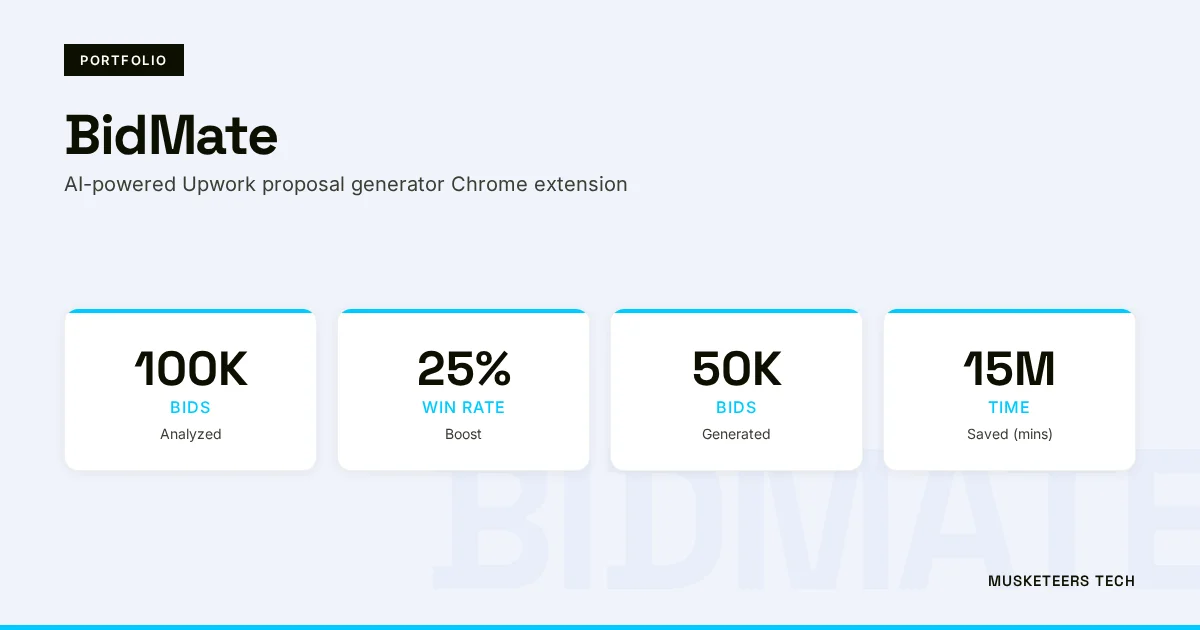
We’ve built and shipped product-grade solutions across AI and web experiences: see examples like BidMate and DoctorDost in our work.
Learn more about our IT Strategy Consulting or see how we helped clients with similar challenges in our portfolio.
MVP Development
Validate fast with sprint-based delivery, measurable milestones, and tight feedback loops.
CTO as a Service
Leadership for Agile planning, engineering health, and cross-team delivery.
Strategy Consulting
Roadmaps, KPIs, and operating models for modern product delivery.
Final Thoughts
What is agile software development? is ultimately a question about how you want to manage uncertainty. Agile isn’t magic, and it isn’t “no process.” It’s a disciplined way to deliver working software frequently, learn from feedback, and adapt while protecting quality.
If you’re choosing between Agile, Scrum, Kanban, or a hybrid approach, focus on the nature of your product: how fast the market changes, how quickly you need feedback, and how costly it is to discover mistakes late. When Agile is implemented with clear ownership, strong engineering practices, and honest metrics, it becomes a competitive advantage, not just a project management style.
Need help with Agile delivery? Check out our MVP development services or explore our recent projects.
Last updated: 01 Feb, 2026