
How Much Does It Cost to Build an AI Agent in 2026? Complete Pricing Breakdown
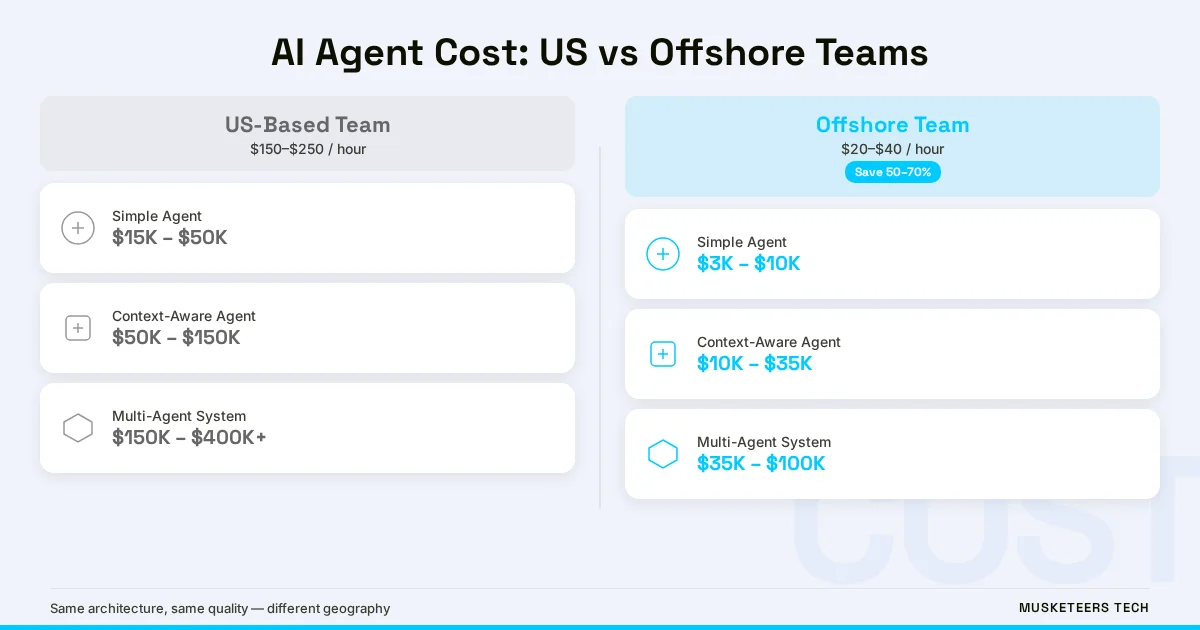
Every executive exploring AI automation eventually asks the same question: how much will this actually cost? The answer depends on complexity, team structure, and — critically — where your development team is based. AI agent development cost in 2026 ranges from $5,000 for a simple rule-based chatbot to over $400,000 for a fully autonomous multi-agent enterprise system. But those headline figures hide the real story. Companies that leverage offshore software development models with rates starting at $20–$40 per hour can build the same caliber of AI agent for 50–70% less than US-based teams charging $150–$250 per hour.
This guide breaks down every cost component — from LLM token spend to infrastructure to ongoing maintenance — and shows you exactly where intelligent budgeting decisions create the biggest impact. Whether you are a startup validating an AI-powered MVP or an enterprise planning a multi-agent deployment, the numbers below will give you the clarity you need to budget with confidence.
Key Takeaways
- AI agent development cost in 2026 ranges from $5,000 for simple chatbots to $400,000+ for enterprise multi-agent systems, with most mid-market projects landing between $25,000 and $120,000.
- The single largest cost variable is your development team’s hourly rate — offshore teams at $20–$40/hour deliver the same quality as US teams at $150–$250/hour, cutting total project costs by 50–70%.
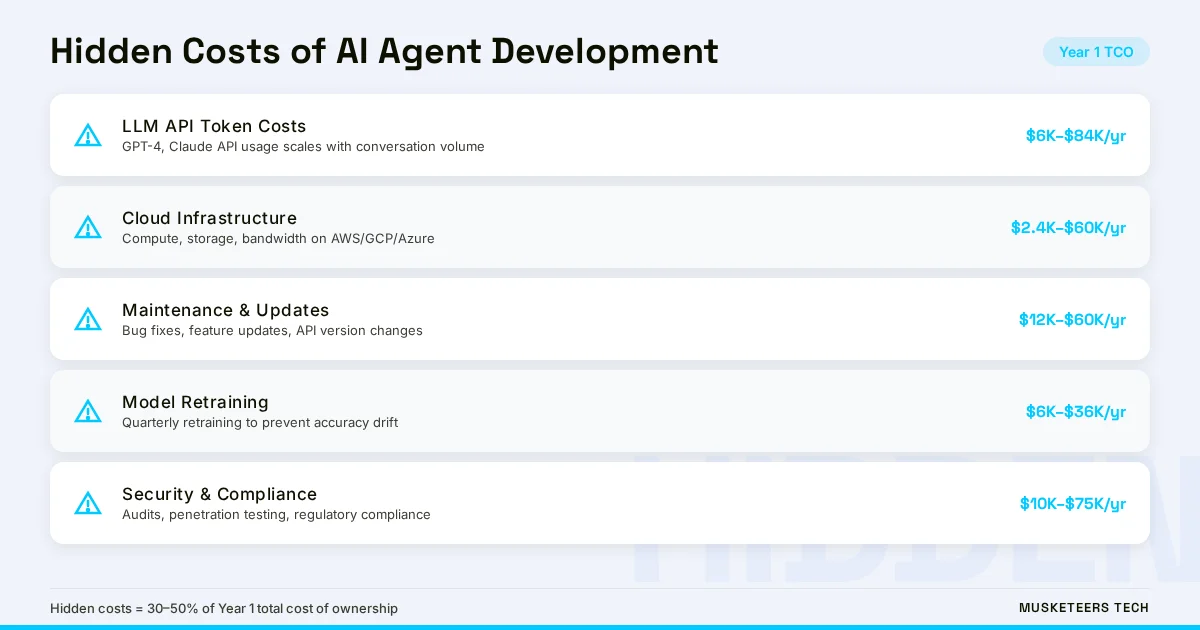
- Hidden costs including LLM API tokens, cloud infrastructure, model retraining, and compliance account for 30–50% of the first-year total cost of ownership.
- A phased MVP approach starting at $10,000–$25,000 lets you validate business value before committing to a full build.
- Build vs. buy decisions should factor in 3-year total cost of ownership, not just upfront investment — custom builds often win at scale.
- ROI timelines of 4–8 months are realistic for well-scoped AI agents that automate high-volume, repetitive workflows.
What Determines AI Agent Development Cost?
Before looking at price ranges, it helps to understand the five factors that drive 90% of the cost variation between AI agent projects.
Complexity and autonomy level is the primary cost driver. A simple FAQ chatbot that matches patterns and returns scripted responses requires minimal engineering. An autonomous agent that reasons across multiple data sources, chains tool calls, manages long-running workflows, and self-corrects requires fundamentally different architecture. The jump from a reactive chatbot to an autonomous agent typically multiplies development cost by 5–10x.
Integration depth determines how much custom middleware and API work is required. An agent that operates standalone costs far less than one that connects to CRMs, ERPs, payment systems, and legacy databases. Each integration adds authentication flows, data mapping, error handling, and testing — typically 40–100 engineering hours per system.
Data requirements cover everything from training data preparation to RAG (Retrieval-Augmented Generation) pipeline setup. Clean, structured data keeps costs low. Messy data spread across multiple systems with inconsistent formats can add $10,000–$50,000 in preprocessing work alone.
Compliance and security needs vary dramatically by industry. A marketing automation agent needs basic security. A healthcare agent handling patient data needs HIPAA compliance, encryption, audit trails, and penetration testing — adding $25,000–$75,000 to the project.
Team location and rate structure is the factor most companies underestimate. A US-based senior AI engineer costs $150–$250 per hour. An equally skilled engineer working through an offshore development partner costs $20–$40 per hour. On a 2,000-hour project, that difference alone accounts for $220,000–$420,000 in savings.
The Rate Multiplier Effect
On a typical mid-complexity AI agent requiring 1,500 development hours, the difference between a US-based team ($150/hr) and an offshore team ($30/hr) is $180,000. That is not a minor budget optimization — it is the difference between building one agent and building three.
AI Agent Development Cost by Complexity Level
The following breakdown reflects 2026 market rates across hundreds of AI agent projects. Costs assume a blended team including AI/ML engineers, backend developers, frontend developers, QA, and project management.
| Agent Complexity | US-Based Team ($150–$250/hr) | Offshore Team ($20–$40/hr) | Timeline | Example Use Cases |
|---|---|---|---|---|
| Simple Reflex Agent | $15,000–$50,000 | $3,000–$10,000 | 4–8 weeks | FAQ bots, lead capture, appointment booking |
| Context-Aware Agent | $50,000–$150,000 | $10,000–$35,000 | 8–16 weeks | Customer support with CRM integration, order tracking |
| Goal-Based Agent | $80,000–$200,000 | $18,000–$50,000 | 12–20 weeks | Sales automation, workflow orchestration, content generation |
| Autonomous Multi-Agent System | $150,000–$400,000+ | $35,000–$100,000 | 20–36 weeks | Supply chain optimization, autonomous decision-making, multi-department coordination |
These ranges cover end-to-end development including discovery, architecture, development, testing, and deployment. They do not include ongoing operational costs, which are covered in a later section.
Simple reflex agents follow predefined rules and decision trees. They handle predictable inputs with scripted responses. Most no-code or low-code platforms can produce basic versions, but custom-built agents deliver better reliability and integration. At offshore rates of $20–$40 per hour, a solid FAQ automation agent with CRM integration can be delivered for under $10,000.
Context-aware agents maintain conversation state, access external data sources through APIs, and adapt responses based on context. These agents use LLMs like GPT-4, Claude, or open-source alternatives and typically include RAG pipelines for accessing business-specific knowledge. This is where most mid-market AI agent development projects land.
Goal-based agents evaluate multiple possible actions to achieve specific business outcomes. They can plan multi-step workflows, use multiple tools, and adjust strategies based on intermediate results. Building these agents requires deeper prompt engineering, more extensive testing, and robust error recovery logic.
Autonomous multi-agent systems represent the most complex and expensive category. Multiple specialized agents coordinate to handle interdependent workflows — one agent might handle data retrieval, another handles analysis, a third generates outputs, and an orchestrator manages the overall flow. These systems require careful architectural planning, extensive testing, and ongoing optimization.
Complete Cost Breakdown by Development Phase
Every AI agent project, regardless of complexity, moves through the same core phases. Understanding what each phase costs helps you budget accurately and identify where to invest versus where to economize.
Discovery and Use Case Definition ($2,000–$8,000)
This phase defines the agent’s scope, identifies integration points, maps data sources, and establishes success metrics. Skipping or rushing discovery is the most common reason AI projects go over budget — ambiguous scope leads to feature creep, rework, and wasted engineering time.
Architecture and System Design ($3,000–$15,000)
Technical architecture determines how the agent processes inputs, accesses data, makes decisions, and delivers outputs. This includes selecting the LLM strategy (API-based vs. self-hosted vs. fine-tuned), designing the RAG pipeline, planning integration middleware, and defining the security model. Decisions made here directly impact every downstream cost.
Model Selection and Prompt Engineering ($5,000–$25,000)
Choosing the right AI model balances capability against cost. GPT-4 and Claude deliver excellent reasoning but cost more per token. Open-source models like Llama 3 and Mistral reduce token costs but require more engineering to achieve equivalent performance. Prompt engineering — crafting the instructions that govern agent behavior — is an ongoing investment that continues well past initial deployment.
Backend Development and Integrations ($10,000–$80,000)
This is typically the largest single cost component. It covers the core application logic, API integrations with CRMs and databases, data pipelines, authentication systems, and the business rules that govern agent behavior. Integration complexity drives cost more than any other single factor — connecting to a modern API with good documentation might take 20 hours, while integrating with a legacy system through custom middleware can take 200 hours.
Frontend and User Interface ($5,000–$20,000)
The user-facing interface might be a chat widget, a dashboard, a voice interface, or an embedded component within existing software. Admin dashboards for monitoring agent performance, reviewing conversations, and managing configuration add to frontend costs. For agents that use MCP (Model Context Protocol), the interface layer can be thinner since MCP handles tool discovery and context management natively.
Testing and Quality Assurance ($5,000–$25,000)
AI agents require different testing strategies than traditional software because outputs are probabilistic rather than deterministic. Testing covers response accuracy, edge case handling, integration reliability, security compliance, and performance under load. For regulated industries, testing can account for 20–30% of the total project timeline.
Deployment and DevOps ($3,000–$12,000)
Setting up production infrastructure, CI/CD pipelines, monitoring, logging, and alerting systems. Cloud deployment on AWS, GCP, or Azure typically costs less upfront than on-premise installations but adds recurring monthly expenses.
A startup building an AI-powered customer support agent with basic CRM integration should expect to spend $10,000–$35,000 at offshore rates. This covers a focused agent handling 3–5 core workflows, integration with one primary system, a simple chat interface, and basic monitoring. Timeline: 6–10 weeks. The key to keeping costs low is ruthless scope discipline — automate the 3 most common customer queries first, prove ROI, then expand.
Hidden and Ongoing Costs Most Companies Miss
The initial build represents only 40–60% of the first-year total cost of ownership. Hidden and ongoing costs catch many organizations off guard because they are not part of the development invoice but show up in monthly operational budgets.
| Cost Category | Monthly Range | Annual Impact | Notes |
|---|---|---|---|
| LLM API Tokens (GPT-4, Claude) | $500–$7,000 | $6,000–$84,000 | Scales directly with usage volume |
| Cloud Infrastructure | $200–$5,000 | $2,400–$60,000 | Compute, storage, bandwidth |
| Model Retraining and Tuning | $500–$3,000 | $6,000–$36,000 | Quarterly retraining to maintain accuracy |
| Monitoring and Observability | $200–$2,000 | $2,400–$24,000 | Performance tracking, error detection |
| Security and Compliance | — | $10,000–$75,000 | Annual audits, penetration testing |
| Maintenance and Updates | $1,000–$5,000 | $12,000–$60,000 | Bug fixes, feature updates, API changes |
| Third-Party API Licenses | $200–$2,000 | $2,400–$24,000 | CRM, email, data enrichment APIs |
LLM API token costs are the most unpredictable ongoing expense. A customer support agent handling 10,000 conversations per month at an average of 1,500 tokens per conversation consumes 15 million tokens monthly. At GPT-4o’s current rates, that is roughly $750–$1,500 per month. Using a mix of models — GPT-4o for complex reasoning, GPT-4o-mini or Claude Haiku for simple queries — can reduce token costs by 40–60% without noticeable quality degradation.
Cloud infrastructure costs depend on deployment architecture. Serverless architectures (AWS Lambda, Google Cloud Functions) keep costs low during quiet periods but can spike during traffic surges. Dedicated instances provide more predictable pricing but require capacity planning. Most AI agent deployments run $500–$3,000 per month for moderate-traffic applications.
Model retraining is necessary because business data changes, product catalogs update, and customer language evolves. Agents that are not periodically retrained experience accuracy drift — they gradually give worse answers as their knowledge base becomes stale. Budget for quarterly retraining cycles at minimum.
The 30% Rule for Year-One Costs
A reliable rule of thumb: multiply your initial development investment by 1.3 to estimate the first-year total cost of ownership. A $50,000 build will cost approximately $65,000 in year one when you include hosting, tokens, maintenance, and monitoring.
The Offshore Advantage: Why Geography Is the Biggest Cost Lever
Most AI agent pricing guides focus on technical complexity as the primary cost driver. They are wrong. The single largest variable in your total project cost is where your development team is located.
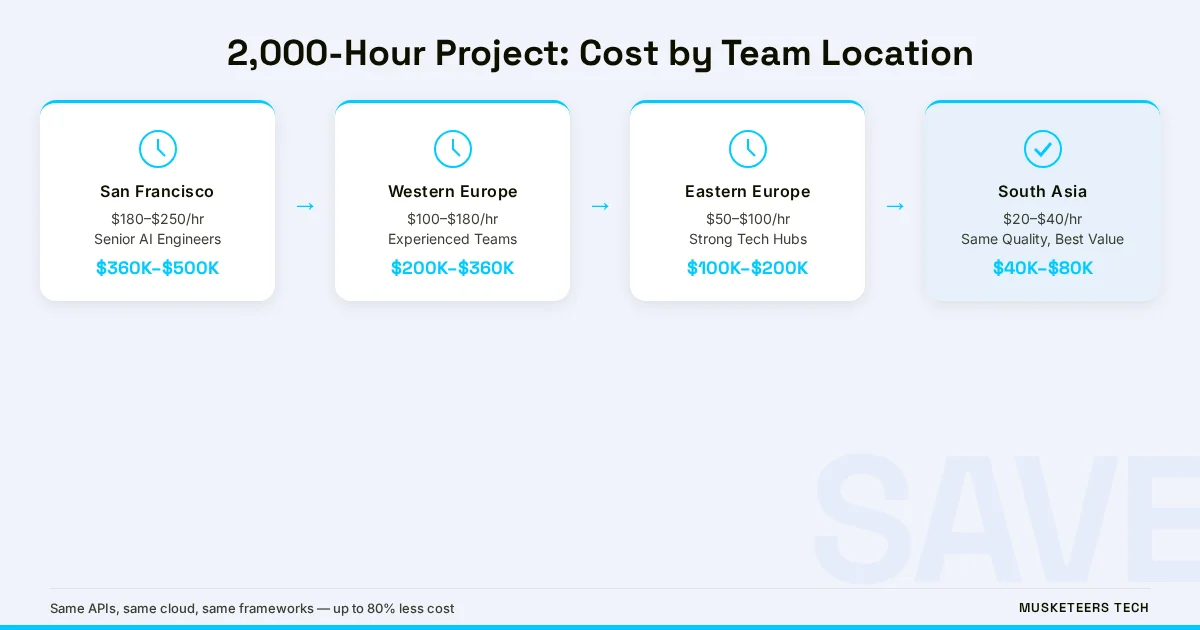
Consider a mid-complexity AI customer support agent requiring 2,000 engineering hours:
| Team Location | Hourly Rate | Total Development Cost | Same Deliverable? |
|---|---|---|---|
| San Francisco / New York | $180–$250/hr | $360,000–$500,000 | Yes |
| Western Europe | $100–$180/hr | $200,000–$360,000 | Yes |
| Eastern Europe | $50–$100/hr | $100,000–$200,000 | Yes |
| South Asia (Pakistan, India) | $20–$40/hr | $40,000–$80,000 | Yes |
The agent architecture, code quality, testing rigor, and deployment standards are identical. The only difference is the cost of engineering talent in each geography. Companies hiring AI agent development services from established offshore partners get the same technical capability at a fraction of the price.
This is not a new concept — the global software industry has operated on distributed development models for two decades. What has changed is that AI-specific expertise is now globally distributed. The same LLM APIs, cloud platforms, and open-source frameworks are available everywhere. An AI engineer in Lahore uses the same OpenAI API, deploys to the same AWS regions, and follows the same architectural patterns as an engineer in San Francisco.
- Offshore AI development teams at $20–$40/hour deliver equivalent technical quality to US teams at $150–$250/hour, verified by code reviews, automated testing, and deployment metrics
- The cost savings enable companies to build more comprehensive AI systems within the same budget — better testing, more integrations, and proper monitoring rather than cutting corners
- Time zone differences actually benefit asynchronous development workflows where progress happens around the clock
- Communication tools, agile methodologies, and shared codebases have eliminated the collaboration friction that once made offshore development risky
- Companies can reinvest the 50–70% savings into longer testing cycles, better infrastructure, and ongoing optimization — the areas where most AI projects actually fail
Build vs. Buy: 3-Year Total Cost of Ownership
The build vs. buy decision requires looking beyond upfront costs to the full 3-year total cost of ownership (TCO). Off-the-shelf AI platforms offer faster deployment but accumulate subscription costs. Custom builds require more upfront investment but provide ownership and control.
| Factor | Off-the-Shelf Platform | Custom Build (Offshore) | Custom Build (US-Based) |
|---|---|---|---|
| Upfront Cost | $5,000–$20,000 | $15,000–$80,000 | $50,000–$300,000 |
| Monthly Recurring | $500–$5,000 | $1,000–$4,000 | $1,000–$4,000 |
| Year 1 Total | $11,000–$80,000 | $27,000–$128,000 | $62,000–$348,000 |
| Year 3 Total | $23,000–$200,000 | $51,000–$224,000 | $86,000–$396,000 |
| Customization | Limited | Full | Full |
| Data Ownership | Vendor controls | You own everything | You own everything |
| Vendor Lock-in Risk | High | None | None |
| Scaling Flexibility | Constrained | Unlimited | Unlimited |
For simple use cases with standard workflows, off-the-shelf platforms like Intercom AI, Zendesk AI, or Drift offer reasonable value. But as requirements grow — custom integrations, proprietary data, industry-specific compliance, multi-agent coordination — the total cost of platform subscriptions often exceeds the cost of building custom, especially at offshore rates.
The hybrid approach works well for many mid-market companies: start with a platform to validate the use case quickly, then migrate to a custom build once requirements stabilize and the business case is proven. This approach minimizes upfront risk while preserving long-term flexibility.
Cost by Industry: Where Compliance Adds to the Bill
Industry-specific requirements — particularly compliance, data handling, and integration with specialized systems — add meaningful cost on top of the base development estimate.
Healthcare AI agents require HIPAA compliance, integration with EHR systems, and strict audit trails. These requirements typically add 40–80% to the base development cost. A mid-complexity healthcare agent that would cost $30,000 as a general-purpose build will cost $50,000–$55,000 with healthcare compliance baked in.
Financial services agents need SOX compliance, fraud detection integration, and real-time risk assessment capabilities. Expect a 50–100% premium over general-purpose agents. The regulatory burden is significant, but so is the ROI — financial services agents routinely deliver 300–500% returns within the first year.
E-commerce and retail agents have lighter compliance requirements but demand deep integration with inventory management, payment processing, and customer behavior analytics. The cost premium is typically 20–40% above baseline, driven primarily by integration complexity rather than compliance.
Legal and professional services agents require document analysis, case law understanding, and confidentiality protections. These agents rely heavily on RAG pipelines with large document corpora, which increases data preparation and infrastructure costs by 30–60%.
The MVP Approach: Validating Before You Scale
The smartest companies do not start with a $200,000 AI agent. They start with a $10,000–$25,000 MVP that proves the business case, then scale investment based on measurable results.
An effective AI agent MVP focuses on one high-impact workflow — the single process that, if automated, would deliver the most measurable value. For most companies, this is customer support ticket deflection, lead qualification, or internal knowledge retrieval.
The MVP approach works because it forces clarity on the exact use case before engineering begins. It produces a working system that generates real performance data. It limits financial exposure while the team learns how to work with AI systems. And it creates a concrete foundation for the next phase of development rather than requiring a rebuild.
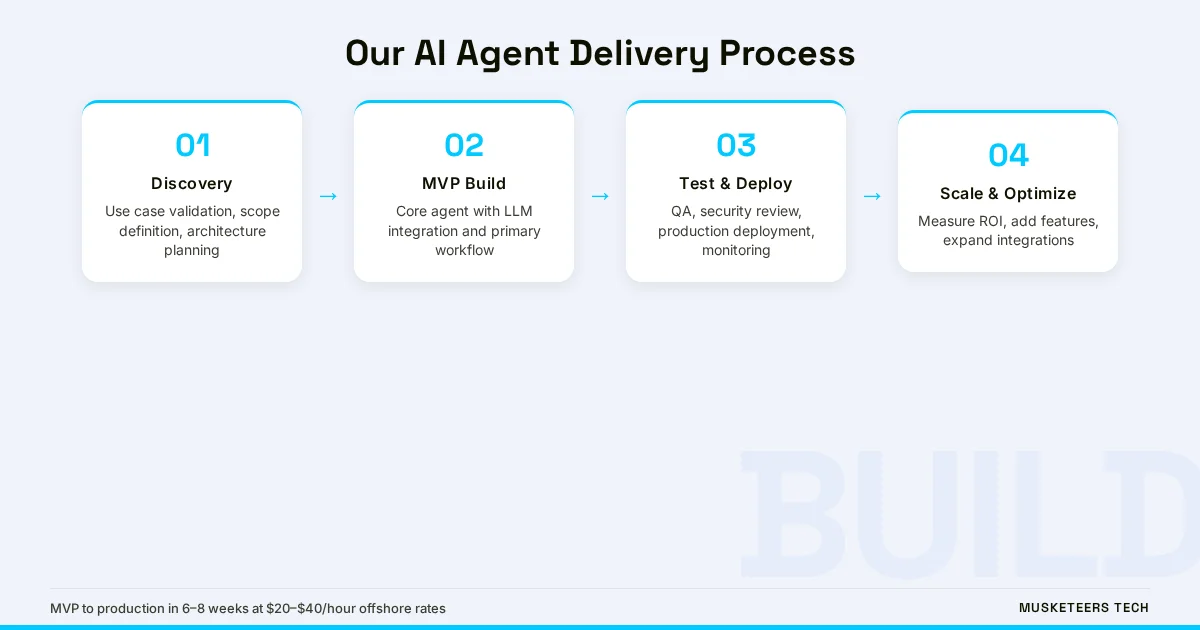
A typical MVP timeline at offshore rates looks like this: weeks 1–2 cover discovery, use case definition, and architecture planning ($2,000–$4,000). Weeks 3–6 cover core development, LLM integration, and primary workflow automation ($5,000–$12,000). Weeks 7–8 cover testing, deployment, and monitoring setup ($3,000–$6,000). Total investment: $10,000–$22,000 for a production-ready agent handling one core workflow.
After the MVP proves value — typically measured by ticket deflection rate, response accuracy, and user satisfaction — companies can make informed decisions about expanding scope, adding integrations, and increasing complexity. This phased approach consistently delivers better outcomes than attempting to build a comprehensive system from day one.
Real Example: AI Voice Ordering Agent
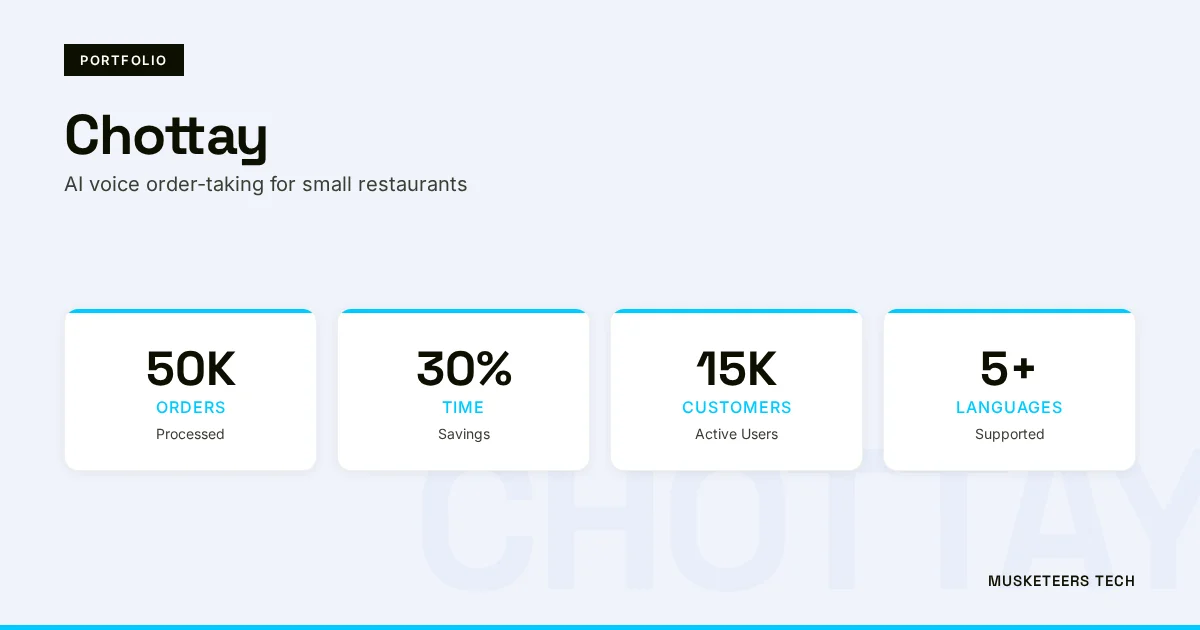
Musketeers Tech built Chottay, an AI voice order-taking system for small restaurants using exactly this phased approach. The MVP focused on voice-based order capture for a single menu format. Once validated, the system expanded to handle multiple restaurant menus, upselling logic, and POS integration. The phased approach kept initial investment under $25,000 while the expanded system now handles thousands of orders daily.
ROI Timelines: When AI Agents Pay for Themselves
AI agents are not cost centers — they are operational investments that generate measurable returns. The payback period depends on the use case, implementation quality, and the baseline cost of the human processes being automated.
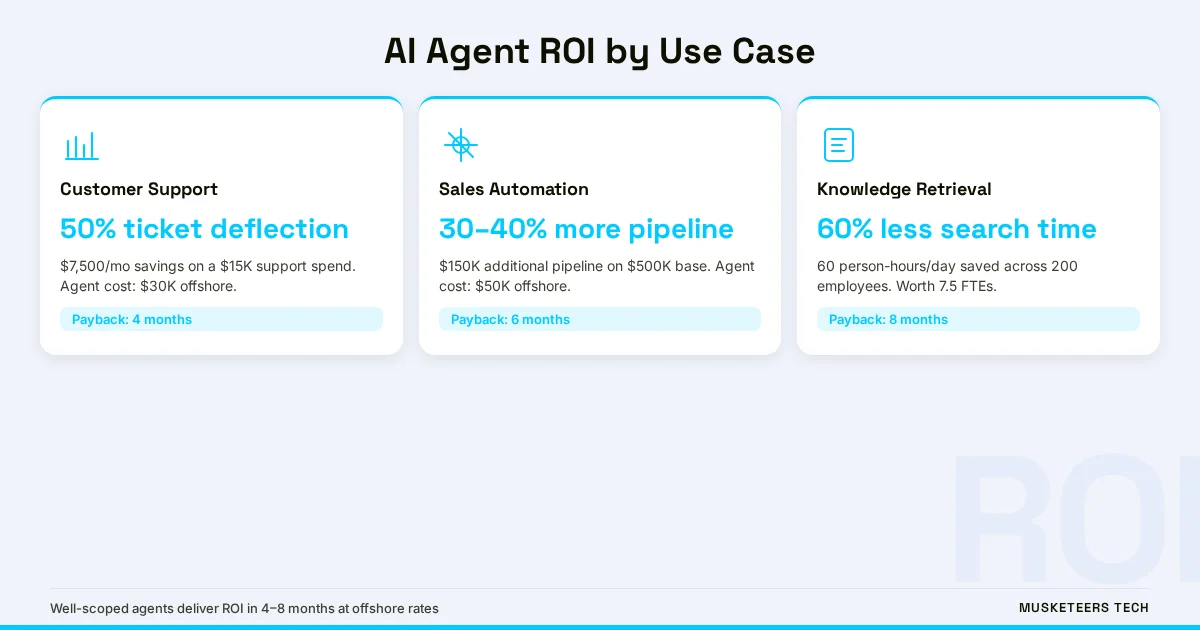
Customer support agents typically deliver the fastest ROI. A company spending $15,000 per month on support staff that deploys an AI agent handling 50% of incoming queries at Tier 1 saves roughly $7,500 per month. Against a $30,000 development investment (offshore rates), the payback period is 4 months. After that, the savings compound.
Sales automation agents take longer to show returns but deliver higher absolute value. Agents that automate lead qualification, outreach personalization, and follow-up sequences can increase qualified pipeline by 30–40%. For a company with a $500,000 annual sales pipeline, a 30% improvement represents $150,000 in additional pipeline — against a $50,000 agent investment.
Internal knowledge retrieval agents save time rather than headcount. If 200 employees each spend 30 minutes per day searching for internal information, that is 100 person-hours daily. An AI knowledge agent that reduces search time by 60% recovers 60 person-hours daily — equivalent to 7.5 full-time employees. The productivity gain at even conservative salary estimates justifies agent investments of $50,000–$100,000 within the first year.
The common pattern across all use cases: well-scoped AI agents that target high-volume, repetitive processes deliver ROI within 4–8 months at offshore development rates. The same agents built at US rates take 12–18 months to achieve payback — same agent, same value, different timeline driven entirely by development cost.
How to Reduce AI Agent Development Cost Without Cutting Quality
Cost optimization is not about spending less — it is about spending smarter. The following strategies consistently reduce AI agent development cost by 30–60% without sacrificing quality or capability.
Start with pre-trained models, not custom training. GPT-4, Claude, Llama 3, and Mistral provide excellent baseline capabilities. Use prompt engineering and RAG pipelines to customize behavior before investing in expensive fine-tuning. Custom model training should only be considered when pre-trained models demonstrably cannot handle your specific use case — which is rarer than most companies assume.
Optimize token usage aggressively. Verbose prompts waste money at scale. A prompt that uses 500 tokens per query instead of 200 costs 2.5x more across millions of interactions. Techniques like prompt compression, response caching for frequent queries, and intelligent model routing (using cheaper models for simple tasks, expensive models for complex ones) can cut token costs by 40–60%.
Use open-source frameworks. LangChain, LlamaIndex, AutoGen, and CrewAI provide battle-tested components for common agent patterns. Building on these frameworks rather than from scratch saves hundreds of engineering hours. Combine them with open-source models for development and testing, switching to commercial APIs only for production workloads.
Choose an offshore development partner. This single decision typically delivers the largest absolute cost reduction. An experienced custom AI development company with offshore rates of $20–$40 per hour provides the same technical expertise, code quality, and project management discipline as US-based firms — at 50–70% lower cost. The savings can be reinvested into better testing, more comprehensive monitoring, and longer optimization cycles.
Design modular architecture from day one. Systems designed as modular components can be expanded incrementally. Adding a new integration or workflow to a well-architected system costs a fraction of adding it to a monolithic build that was not designed for extensibility.
How to Choose the Right AI Agent Development Partner
Selecting the wrong development partner is the fastest way to turn a $50,000 project into a $150,000 failure. The right partner delivers working systems on budget and on time. Here is what to evaluate.
Demonstrated AI expertise matters more than general software development experience. AI agent development requires specific knowledge of LLM architectures, prompt engineering, RAG pipelines, vector databases, and agent orchestration frameworks. Ask for case studies showing production AI agents, not just traditional software projects.
Transparent pricing and scope management separate professional firms from those that rely on scope creep for revenue. Your partner should provide detailed estimates broken down by phase, with clear change order processes for scope additions. Fixed-price contracts for well-defined phases reduce your financial risk.
Post-deployment support is essential because AI agents require ongoing optimization. Your partner should offer maintenance packages covering model retraining, performance monitoring, bug fixes, and feature updates. A partner who disappears after deployment leaves you with a depreciating asset.
Industry and compliance experience matters if you operate in regulated industries. Partners who have built HIPAA-compliant healthcare agents or SOX-compliant financial agents bring compliance knowledge that saves weeks of research and reduces the risk of costly audit failures.
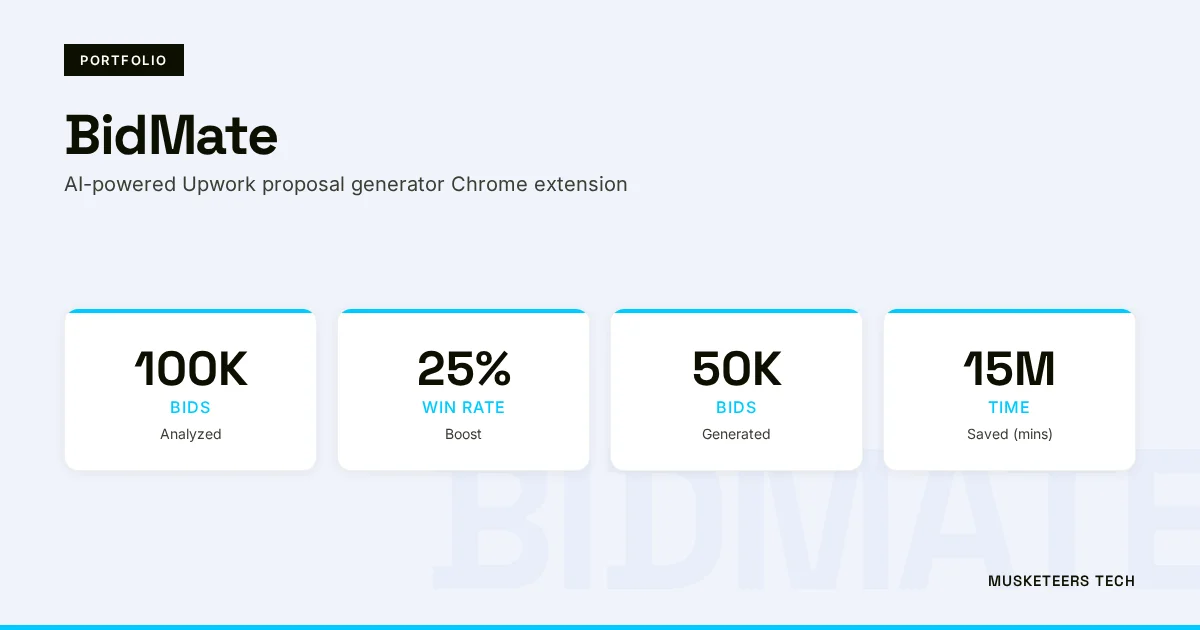
Musketeers Tech has delivered production AI agent systems including AI-powered voice ordering, AI proposal generation, and enterprise automation platforms. With offshore rates starting at $20 per hour and a team experienced in designing APIs for AI agents, we consistently deliver AI systems at 50–70% below US market rates without compromising on architecture, testing, or deployment quality.
Frequently Asked Questions
A basic AI chatbot with FAQ handling and simple integrations costs $3,000–$10,000 when built by an offshore team at $20–$40/hour. The same chatbot built by a US-based team costs $15,000–$50,000. No-code platforms can produce simpler versions for under $1,000, but these typically lack the integration depth and reliability needed for business-critical use cases.
How Musketeers Tech Can Help
Musketeers Tech is an AI agent development company that has built production AI systems across industries — from voice-powered ordering agents to intelligent proposal generators. Our offshore development model delivers enterprise-quality AI agents at rates starting from $20 per hour, which means you get the same architecture, code quality, and testing rigor as US-based firms at 50–70% lower cost.
We specialize in the phased approach described in this guide: validate with a focused MVP, measure results, then scale investment based on proven value. Our team brings deep expertise in LLM integration, generative AI applications, RAG pipeline architecture, and MCP protocol implementation — the building blocks of every modern AI agent. For CTOs evaluating AI investments, our fractional CTO service provides senior technical leadership to guide architecture decisions, vendor selection, and build vs. buy strategy without the overhead of a full-time executive hire.
Whether you are building your first AI agent or scaling an existing system, get in touch for a detailed cost estimate tailored to your specific use case, integrations, and timeline requirements.
AI Agent Development
Production-ready AI agents built at offshore rates starting $20/hour with enterprise-grade quality.
Generative AI Applications
Custom LLM-powered applications including RAG pipelines, content generation, and intelligent automation.
Final Thoughts
AI agent development cost in 2026 is no longer the barrier it was even two years ago. Infrastructure costs have dropped, open-source tools have matured, and the global distribution of AI talent means companies no longer need Silicon Valley budgets to build Silicon Valley-quality AI systems. The companies seeing the best returns are not necessarily the ones spending the most — they are the ones making smarter decisions about scope, team structure, and phased investment.
Start with a focused MVP that targets your highest-value workflow. Measure results against clear business metrics. And when the numbers prove the value, scale with confidence knowing exactly what each incremental investment will deliver.
The cost question is important. But the more important question is: what is the cost of not building an AI agent while your competitors already are?
Last updated: 02 Apr, 2026
