Claude Design: A Founder’s Guide to Prompt-to-Product
Anthropic launched Claude Design on April 17, 2026, and founders immediately noticed something different about it. It is not another AI image generator, another wireframing tool, or another no-code canvas. Claude Design is a Claude-powered environment where you describe a product in plain English and walk away minutes later with interactive prototypes, branded pitch decks, and polished UI mockups that look like a senior product designer spent a week on them. For anyone who has ever stared at a blank Figma file at 2 a.m. trying to translate a startup idea into visuals, the shift is significant.
This guide is written for founders and business decision-makers who are hearing about Claude Design for the first time and want to understand what it can actually do, how it fits into a real startup workflow, where it helps most, and where it still falls short of a production-ready product. We will cover the mechanics, the practical use cases, a comparison with tools like Lovable, Figma Make, and v0, and the critical moment every founder eventually hits: when prompt-to-prototype stops being enough and you need a real engineering partner to take the idea the rest of the way.
Key Takeaways
- Claude Design is Anthropic’s new prompt-to-product environment that generates interactive prototypes, pitch decks, and UI mockups from natural-language descriptions, launched April 17, 2026 and powered by Claude Opus 4.7.
- Founders are using it to compress weeks of early-stage design work into hours, which changes how fast an idea can go from napkin sketch to investor conversation.
- It is excellent for pre-seed validation, user testing, pitch prep, and internal alignment, and it is not a replacement for production engineering, accessibility audits, or scalable architecture.
- The biggest founder mistake is treating a beautiful Claude Design prototype as a finished product. Investors and early users see through polished UIs that have no working backend within minutes.
- A pragmatic workflow combines Claude Design for speed of ideation with an experienced MVP development partner to turn the concept into a production system that can actually take paying customers.
- Tools like Claude Design, Lovable, and Replit each solve different slices of the problem, founders who combine them with real engineering discipline ship meaningfully faster than those who lean on any single tool.
What Is Claude Design?
Claude Design is Anthropic’s prompt-to-product creation environment, launched on April 17, 2026 as part of the Claude Labs program and powered by Claude Opus 4.7. Founders describe a product, page, flow, or pitch in plain English, and Claude Design responds with interactive prototypes, complete UI screens, branded decks, and editable design systems that can be iterated on with follow-up prompts. Unlike generic AI image tools, every output is structured: meaning buttons, navigation, typography, and layout are rendered as editable components rather than flat pictures.
The product matters because it collapses a stage of startup work that has traditionally taken weeks. A founder with a one-paragraph idea used to need a designer, a prototyping subscription, a brand kit, and a runway of evenings before they could show a coherent vision to anyone. Claude Design hands them a polished draft in the time it takes to brief a junior designer on the problem. For generative AI applications, this represents the same leap that image generators made for marketing teams two years ago. The work is now cheap enough that founders will do more of it, not less.
Why the April 2026 Launch Matters
Claude Design is the first major prompt-to-product tool from a frontier AI lab aimed directly at founders rather than designers. It signals that the AI industry sees early-stage entrepreneurship, not enterprise design teams, as the next mass market for generative interface tools.
How Claude Design Works Under the Hood
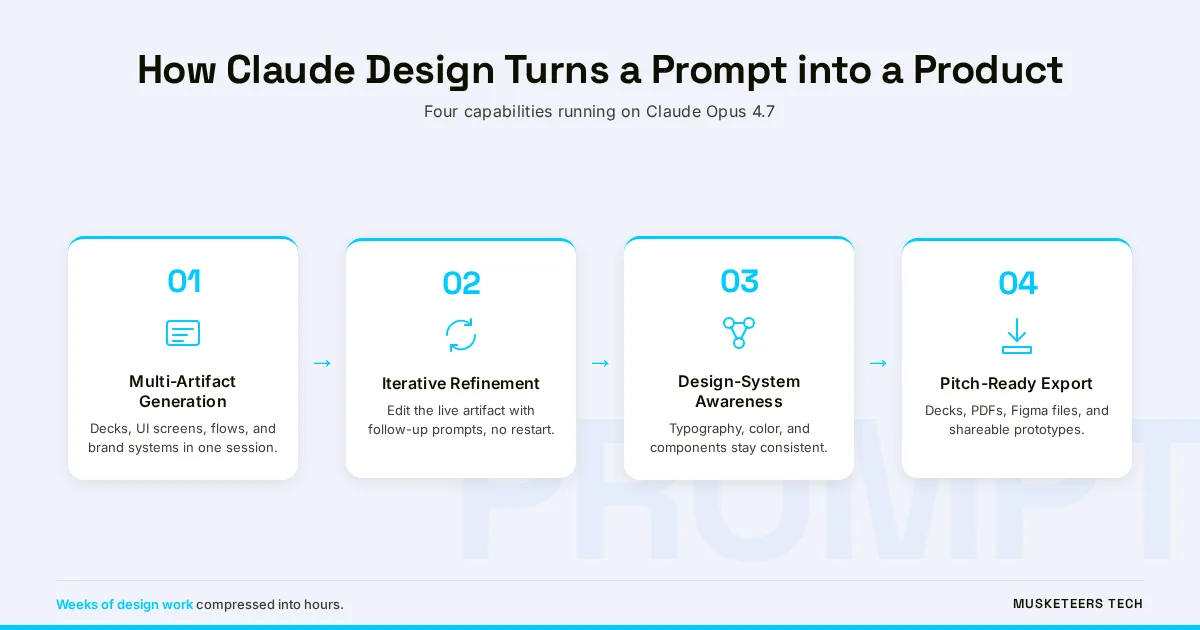
Claude Design runs on Claude Opus 4.7, Anthropic’s most capable model, with a specialized design toolkit layered on top. When a founder submits a prompt, the system does not just generate a picture. It plans a product. It infers the user persona, the primary jobs-to-be-done, the information architecture, the visual tone, and the component structure, then renders each screen as a real interactive artifact rather than a static mockup.
Four capabilities make this possible. First, multi-artifact generation lets Claude produce decks, UI screens, flows, and brand systems in a single session without losing context. Second, iterative refinement means you can say “make the hero more confident” or “move the pricing table above the testimonials” and Claude edits the live artifact rather than regenerating from scratch. Third, design-system awareness means typography, color tokens, spacing, and interactive states are consistent across every screen in a project. Fourth, pitch-ready export produces slide decks, PDFs, Figma-compatible files, and shareable web prototypes, not just screenshots.
The practical implication for founders is that a single person can hold the roles of product manager, designer, and pitch-deck author for the first 48 hours of an idea. That compression is the whole point. Whether you then ship the prototype as a real product depends entirely on what you do with that head start.
What Founders Can Actually Build with Claude Design
The tool is already being used across a surprisingly wide range of early-stage work. Here are the categories where founders are getting the most traction in the first weeks of availability.
- Pre-seed pitch decks with matching product mockups: a 12-slide deck plus a click-through prototype of the hero flow, ready for a warm intro in under two hours.
- Landing pages for waitlist campaigns: headline, subhead, feature blocks, social proof section, and signup form generated with consistent brand voice across all copy and visuals.
- User research prototypes: five to eight linked screens that can be handed to test users to validate a flow before any code is written.
- Internal alignment artifacts: when a founding team cannot agree on what the product should look like, a Claude Design draft forces the conversation toward concrete decisions instead of abstract debate.
- Investor update visuals: founders shipping quarterly updates use Claude Design to turn roadmap text into polished diagrams and progress screens that make decks feel professional.
- Brand system v0: logos, color tokens, typography pairings, and component examples generated together so the eventual designer has a starting point rather than a blank page.
What founders are not using it for, at least not successfully, is anything that needs real data, real integrations, or real users transacting money. That is the line that trips up first-time users, and it is worth understanding why before you build anything you plan to ship.
Claude Design vs. Traditional Prototyping
To understand where Claude Design earns its place, compare the typical founder workflow before April 2026 with what is possible today.
| Stage | Traditional Workflow | With Claude Design |
|---|---|---|
| Idea to visual concept | 2–4 weeks (hire designer, brief, iterate) | 30 minutes to 2 hours |
| Pitch deck with branded visuals | 1–2 weeks + $1,500–$5,000 designer fee | 2–4 hours, zero external spend |
| Interactive prototype for user testing | 3–6 weeks + $3,000–$10,000 | Same day, iterative refinement in minutes |
| Brand system v0 | 2–3 weeks with a brand designer | Generated in one session, refined across prompts |
| Landing page ready for waitlist | 1–2 weeks + developer or Webflow expert | Hours, with exportable code |
| Production-ready product | Not addressed by prototyping tools | Still not addressed: requires engineering |
The pattern should be obvious. Claude Design compresses the work that happens before a line of production code is written. It does not compress the engineering, security, compliance, or integration work that comes after validation. Founders who miss that distinction end up with beautiful prototypes and no business. Founders who understand it ship functional MVPs faster than ever before.
The Prompt-to-Product Workflow Founders Should Use
Getting strong outputs from Claude Design is less about clever prompting and more about structured thinking. The founders having the best outcomes follow a four-step loop that looks less like design and more like product discovery.
Step one: write a user-problem brief, not a feature list. Claude Design performs dramatically better when you describe the user and the problem than when you describe screens. A brief like “a solo freelancer who needs to send professional invoices and track which ones are overdue” produces a coherent product. A brief like “invoice list page with filters and a button” produces a generic CRUD screen.
Step two: generate the full product, then subtract. Ask Claude Design for every screen the product could need: onboarding, empty states, settings, billing, the works. Then delete or hide everything that is not essential to the first user journey. Founders instinctively add features. Claude Design lets you start with abundance and ruthlessly cut, which mirrors how good products actually get scoped.
Step three: refine with specific, visual language. Generic feedback produces generic edits. “Make the pricing page feel like Linear” or “this should look like a neobank, not a spreadsheet” gives Claude the specificity it needs. Screenshots of reference products pasted into prompts work remarkably well.
Step four: export early and test with real humans. The biggest mistake is treating the Claude Design canvas as the finish line. Export to a shareable prototype link, send it to five target users, and watch them interact with it. The feedback will tell you whether the concept works, and whether it is time to bring in a real engineering team.
A Prompt Is Not a Product Spec
Claude Design will happily generate a prototype for almost any prompt. That is a feature and a trap. A beautiful prototype that solves the wrong problem is more dangerous than no prototype at all, because it creates false confidence. Start every session with a user-problem brief and validate the problem with real users before investing in engineering.
Where Claude Design Fits and Where It Doesn’t
Every tool has a zone where it creates disproportionate value and a zone where using it costs you time. For Claude Design, those zones are fairly clear after the first weeks of usage data.
Fundraising pitch decks, early-stage landing pages, user-research prototypes, internal alignment drafts, brand system starting points, investor update visuals, hackathon submissions, agency pitch mockups, and any situation where speed-to-visual matters more than production fidelity. If your deadline is measured in hours or days and your audience will not try to charge their credit card on the prototype, Claude Design probably beats every other option.
The boundary is not a limitation of AI design tools. It is a limitation of what a prompt can specify. Production systems encode thousands of edge-case decisions, security trade-offs, and domain-specific rules that no prompt can enumerate. Founders who understand this draw the line correctly and use the right tool at each stage.
Claude Design vs. Lovable, Figma Make, v0, and Replit
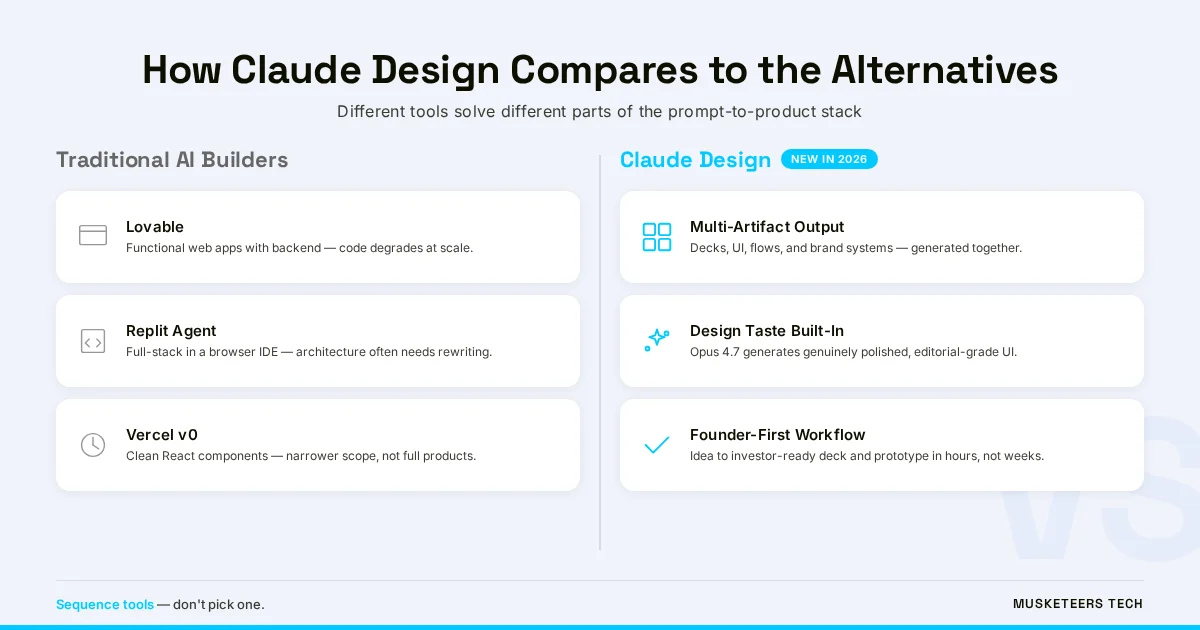
Claude Design did not launch into an empty market. Tools like Lovable, Figma Make, Vercel’s v0, and Replit Agent have been pushing on the prompt-to-product frontier for over a year. Each solves a different part of the problem.
| Tool | Primary Strength | Best For | Key Limitation |
|---|---|---|---|
| Claude Design | End-to-end product artifacts (UI + deck + brand) with strong design taste | Founders going from idea to investor-ready in days | New product: ecosystem still forming |
| Lovable | Generates functional web apps with backend logic | Technical founders building working prototypes | Code quality degrades at scale: founders often outgrow Lovable |
| Figma Make | AI inside Figma’s familiar canvas | Designers extending existing Figma workflows | Requires Figma fluency; weaker on code output |
| Vercel v0 | UI component generation with clean React output | Developers needing production-ready UI code | Narrower scope: focuses on components, not full products |
| Replit Agent | Full-stack app generation inside a browser IDE | Prototypes that need a database and auth out of the box | Code architecture often needs rewriting: most teams eventually outgrow Replit |
The smart play for founders is not to pick one tool. It is to sequence them. Use Claude Design for the visual and narrative clarity of the idea, use Lovable or Replit to stand up a quick functional prototype, and bring in a dedicated engineering team the moment real users or real money enter the picture. That transition point is where startups either accelerate or stall, and it is the single most important decision in the early product journey.
Common Mistakes Founders Make with AI-Generated Prototypes
The patterns that trip up first-time users of Claude Design are remarkably consistent. Avoiding them is worth more than any prompting tip.
Mistaking a prototype for a product. A prototype simulates a product. It does not run one. Founders who pitch investors with “our app” when the thing they are demoing has no backend get exposed during due diligence. Be honest about what stage you are at and use the prototype as a vision document, not a proof of execution.
Skipping user validation because the mockup looks finished. When a prototype looks polished, it feels like the hard work is done. It isn’t. The only thing that validates a product is real users doing a real job with it. Put prototypes in front of target users and watch where they get stuck.
Letting Claude Design design the architecture. The visual design of a product is not its architecture. A Claude Design prototype can show you what your app might look like. It cannot tell you whether your chosen tech stack will scale, whether your integrations will survive real API traffic, or whether your data model supports the workflows the UI implies. Those decisions still need an experienced technical lead or fractional CTO.
Delaying the handoff to engineering. Every week spent polishing a prototype after you have validated the problem is a week not spent building the product that will actually make money. Once the concept is validated, move to real engineering quickly. Holding onto the prototype phase because it is fast and fun is one of the most expensive mistakes a first-time founder makes.
Using AI-generated copy without editing. Claude Design produces competent copy. Competent is not memorable. Every word on a founder’s landing page or pitch deck should be sharpened by a human who deeply understands the customer. Treat AI copy as a first draft, not a final deliverable.
Frequently Asked Questions
Claude Design is available as part of the Claude Pro and Claude Max subscriptions on Claude.ai, with a limited free tier available for exploration. Pricing has not been fully detailed beyond the existing Claude subscription tiers, and Anthropic has indicated that usage limits may apply to the most compute-intensive generation tasks. Check the official Anthropic pricing page for the latest details.
How Musketeers Tech Can Help
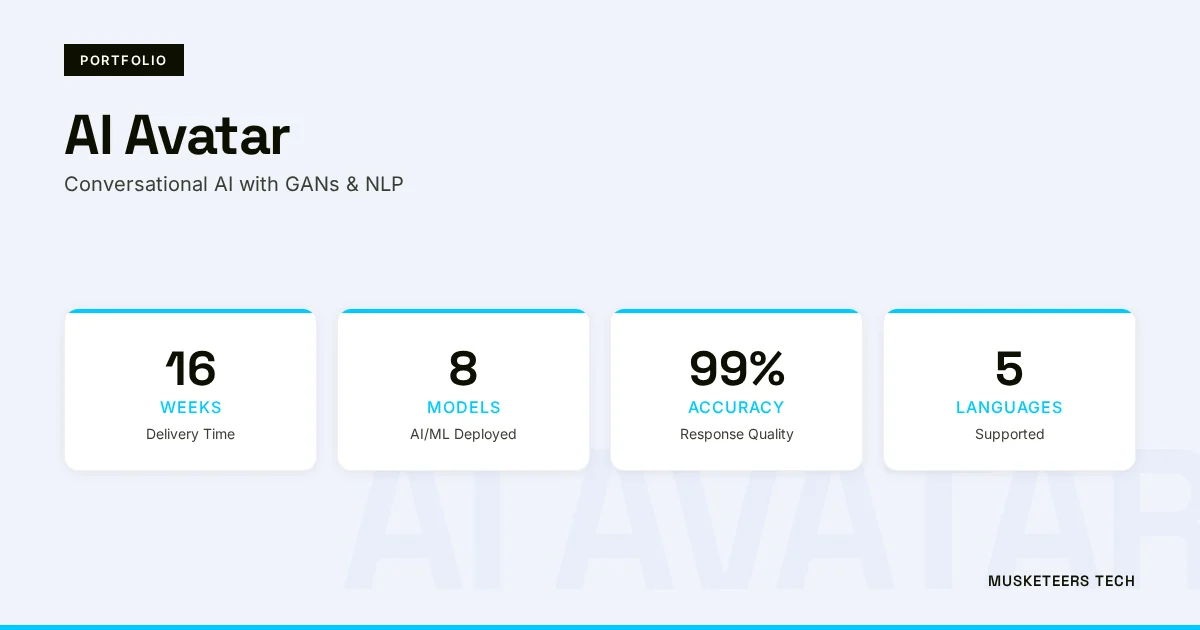
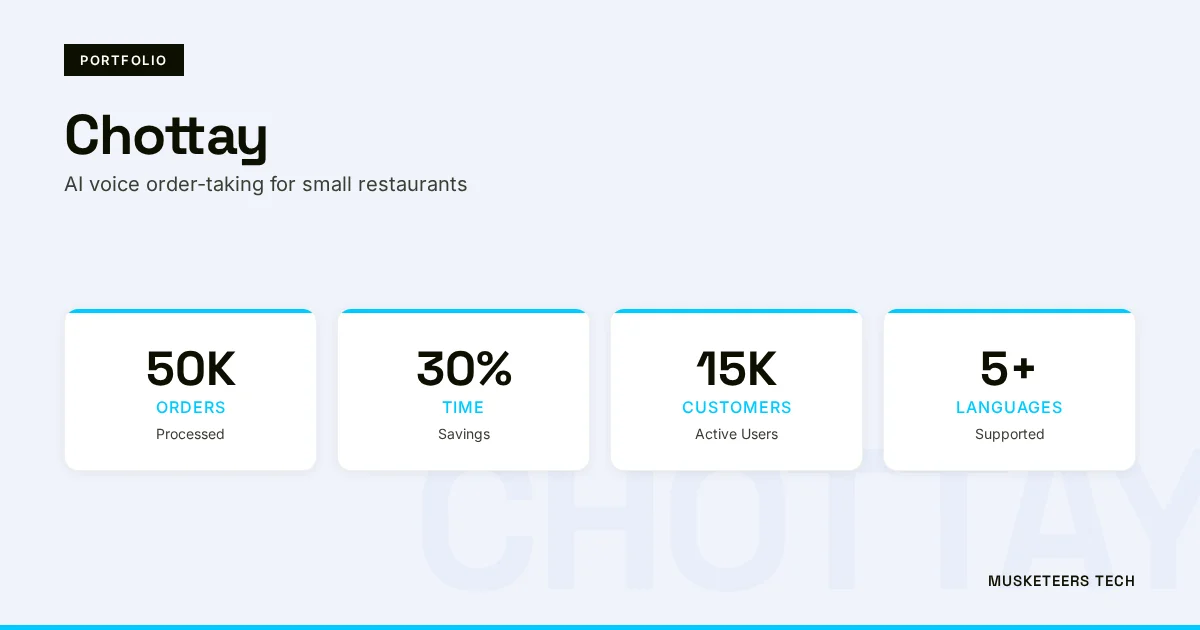
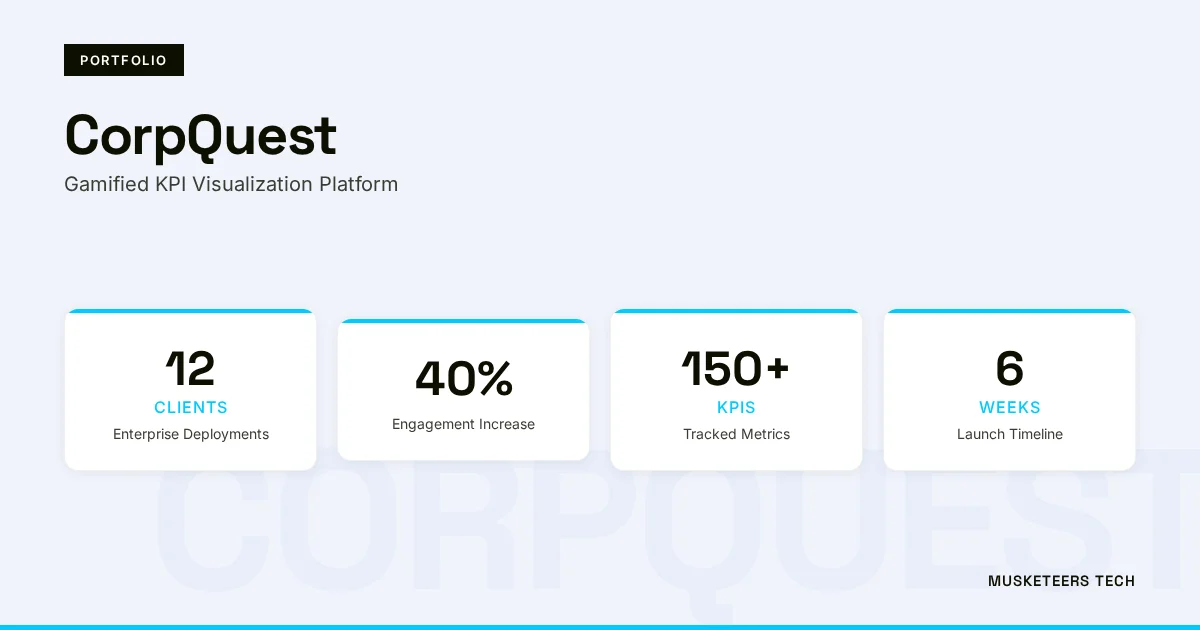
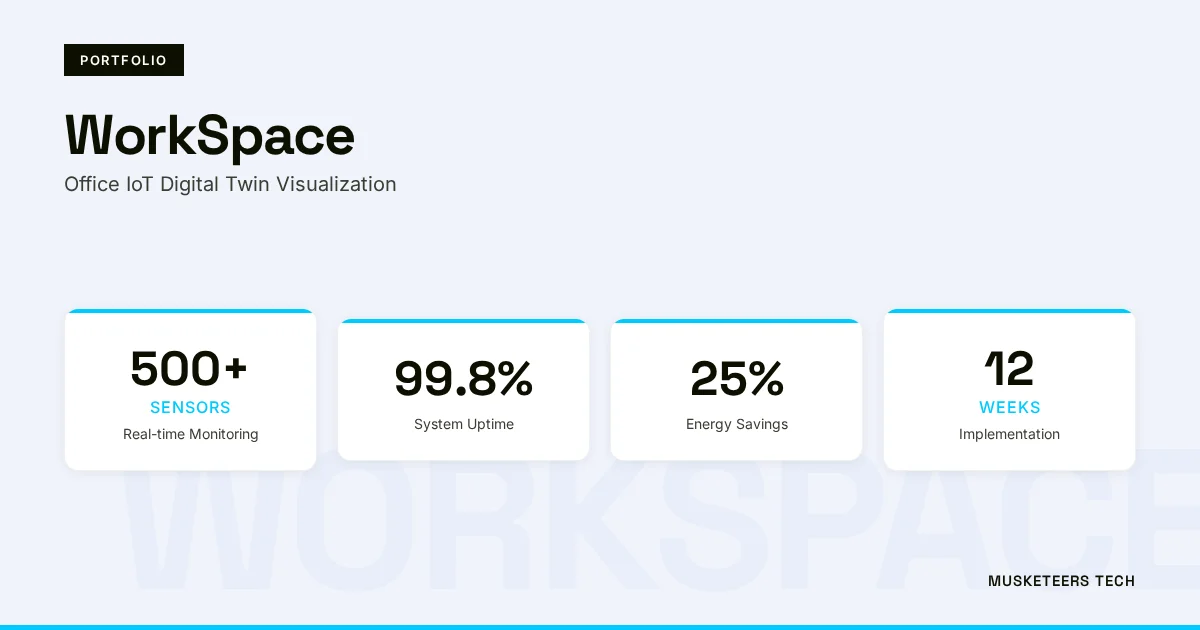
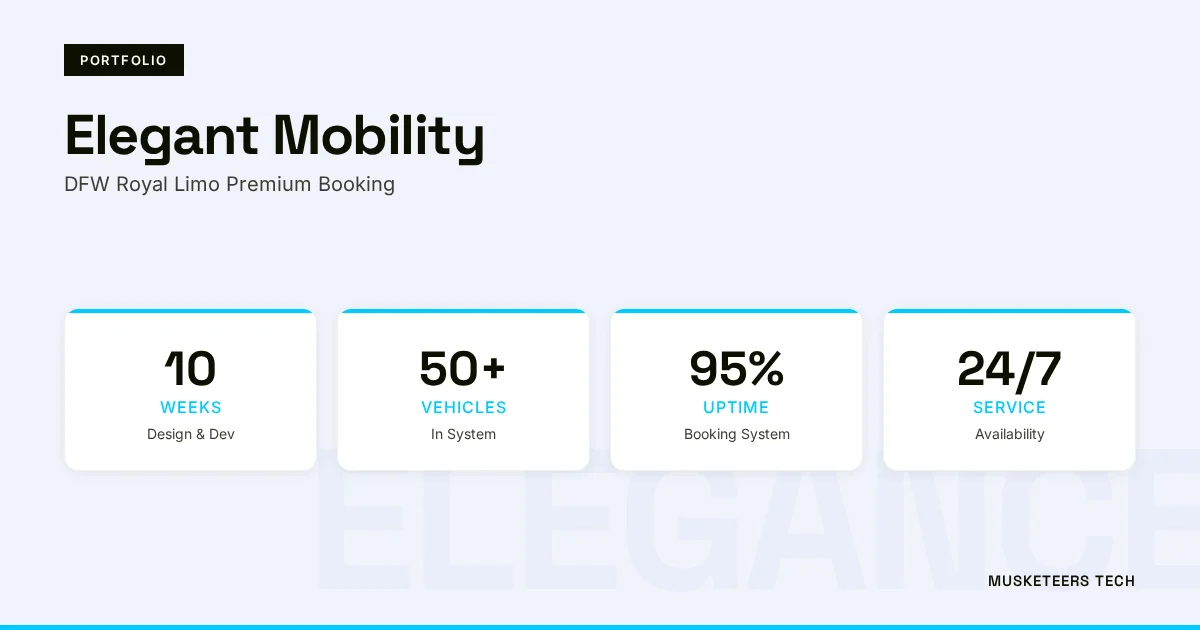
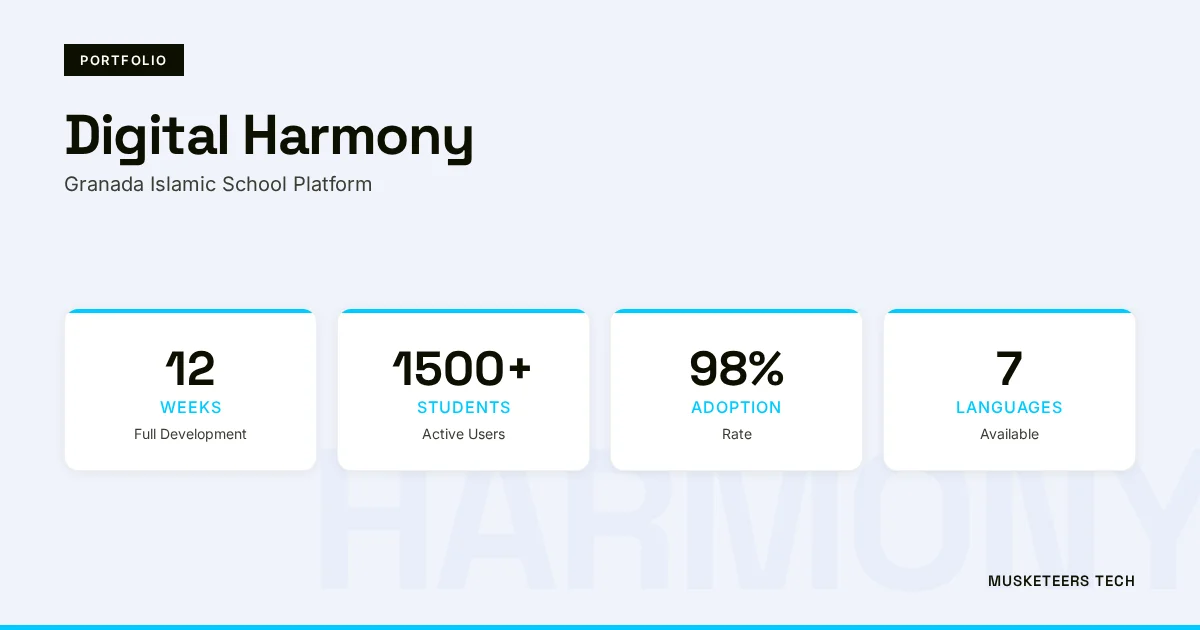
Musketeers Tech is an MVP development company that specializes in exactly the transition Claude Design does not cover: taking a validated concept and turning it into a production product that can handle real users, real data, and real revenue. Our team has shipped AI-native products ranging from AI voice ordering systems to AI proposal assistants to AI avatar platforms, and we understand how to translate a polished prototype into an architecture that scales.
The playbook we run with founders is simple. Bring us the Claude Design prototype, the user feedback from your first round of testing, and a clear sense of the business model. We come back with a phased engineering plan: a focused MVP build first, followed by the integrations, compliance, and infrastructure work needed as you grow. Our offshore rates start at $20 per hour, which means the cost of moving from prototype to production is a fraction of what US-based firms charge, and our experience with AI agent development, generative AI applications, and CTO-as-a-service engagements means we can step in as the technical co-founder your idea needs.
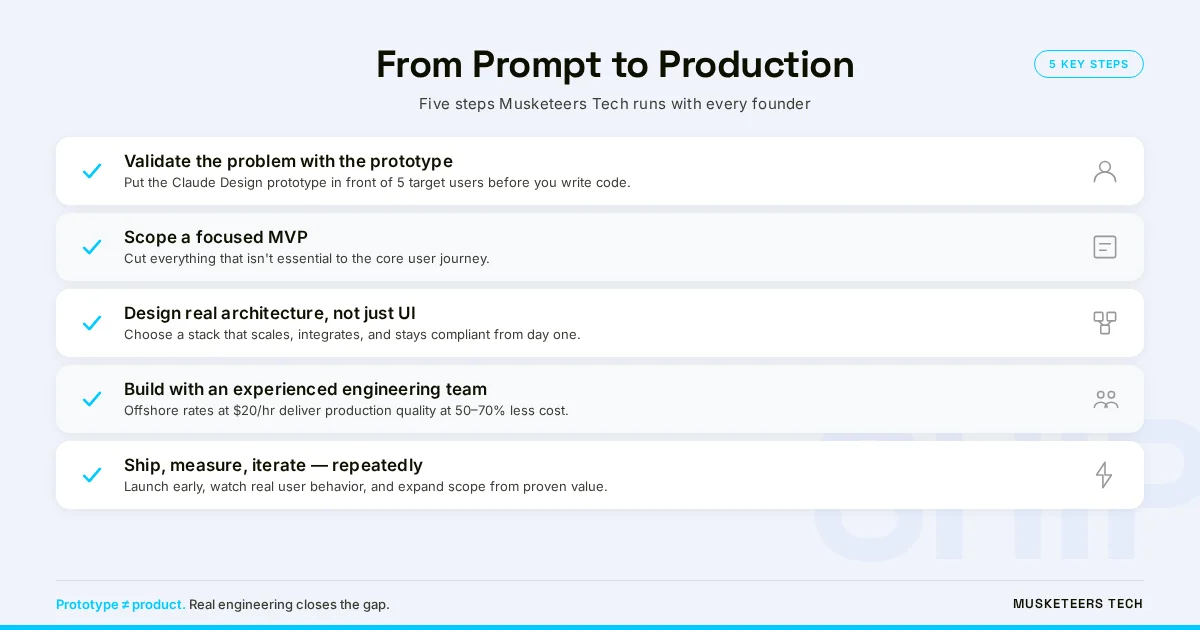
If you are holding a Claude Design prototype and wondering what the next step looks like, get in touch. We will tell you honestly whether your concept is ready for an engineering build, what it should cost, and how quickly we can get you to a product your early users can actually pay for.
MVP Development
Ship a production-ready MVP built on a validated prototype: offshore rates, enterprise-grade quality.
Bespoke Applications
Custom-engineered products that take your Claude Design concept to scalable reality.
Final Thoughts
Claude Design is the clearest signal yet that the early-stage startup stack is being rewritten in favor of founders who can move from idea to artifact faster than anyone before them. A solo entrepreneur in 2026 can now generate the visual and narrative assets of a seed-stage startup in an afternoon. Work that used to require weeks, thousands of dollars, and a rolodex of freelancers.
That head start is real, and it is worth taking. But it is only a head start. The finish line is still a working product that solves a real problem for real users who are willing to pay. Prompt-to-product tools get you to the starting gun faster. Getting across the finish line still requires the same disciplines it always has: customer validation, technical architecture, engineering execution, and the judgment to know when to stop prototyping and start building.
The founders who will win this cycle are the ones who use Claude Design for what it is good at, respect its limits, and partner early with an engineering team that can take the validated concept the rest of the way. If you are one of them, we would love to help.
Last updated: 20 Apr, 2026