
What are The Types of Software Development
Choosing between web vs mobile, Agile vs Waterfall, or DevOps vs traditional SDLC can feel like comparing apples, oranges, and the orchard. That’s because types of software development gets used to mean three different things:
- What you’re building (e.g., a web app vs an embedded system)
- How you’re building it (e.g., Agile vs Waterfall vs DevOps)
- How your team delivers it (e.g., in-house, co-development, nearshore)
This guide clears up that ambiguity with a practical taxonomy, real examples, and a simple selection matrix you can use for planning an MVP, modernizing an enterprise system, or building an AI product. You’ll also see where the software development life cycle (SDLC) fits in and how modern teams use AI-assisted tooling in 2026 without compromising quality or security.
A 3-layer map for clarity
To pick the right approach, first separate:
- Project type (web, mobile, embedded, data/ML)
- SDLC model (Waterfall, Agile, DevOps, Spiral, RAD…)
- Team delivery model (in-house, co-development, nearshore/offshore)
What are the types of software development? (A practical taxonomy)
At a high level, “types of software development” can be organized into three layers. Thinking in layers helps you avoid the most common planning mistake: picking a methodology before you’ve clarified the product and constraints.
Layer 1: Types by platform / project (what you’re building)
This is the “category of software” you’re delivering: web, mobile, embedded, data/ML, and so on.
Layer 2: Types by SDLC model / methodology (how you build and release)
These are the frameworks that shape planning, iteration cadence, testing strategy, and change management (e.g., Waterfall, Agile, DevOps, Spiral). IBM summarizes these as “software development models” that dictate workflow and communication patterns across the lifecycle (SDLC). Source: IBM — Software Development
Layer 3: Types by delivery/engagement model (how the team is organized)
This is how your organization sources and runs development: in-house, outsourced, co-development, nearshore/offshore, dedicated team, etc.
If you’re also evaluating Agile specifically, see our deeper explainer: what Agile software development is and how it works
Types of software development by platform/project (with examples)
Below are the most common project categories you’ll see in modern product roadmaps. (This aligns with how list-focused SERP results break down “types” into web/mobile/desktop/game/embedded/data/ML.)
| Project type | Typical outputs | Common tech choices | Best for |
|---|---|---|---|
| Web development | Websites, dashboards, portals, SaaS | React/Next.js, Node, Python, .NET, PostgreSQL | Fast iteration, broad device access |
| Mobile app development | iOS/Android apps, mobile-first products | Swift/Kotlin, Flutter/React Native, Firebase | High engagement, offline + device features |
| Desktop application development | Windows/macOS tools | Electron, .NET/WPF, Qt | Specialized workflows, enterprise tooling |
| Game development | 2D/3D games, simulations | Unity, Unreal, Godot | Real-time rendering + physics |
| Embedded systems development | Firmware, device control software | C/C++, RTOS, embedded Linux | IoT, robotics, automotive, medical devices |
| Data science & ML development | Models, pipelines, inference APIs | Python, PyTorch, TensorFlow, MLOps tooling | Prediction, personalization, automation |
Planning tip
Platform type determines your non-negotiables (latency, offline mode, security, device access, compliance), which should influence your SDLC model and tooling.
Types of software development methodologies (SDLC models) + comparison
Two competitors in the SERP focus heavily on methodologies (Comidor, Itransition), and IBM also covers models. So we’ll keep this section decision-oriented.
Sequential vs Agile: what’s the real difference?
- Sequential (plan-driven) models optimize for predictability and documentation when change is expensive.
- Agile (iterative) models optimize for learning, iteration speed, and adapting to shifting requirements.
Itransition notes Agile adoption continues to rise and cites industry reporting (e.g., State of Agile). See: Itransition — Methodologies and State of Agile (digital.ai)
Best when requirements are stable and audited. Typical traits:
- Heavy upfront planning and documentation
- Linear phases and stage gates (e.g., Waterfall, V-Model)
- Strong traceability, slower change
Good for: safety-critical, regulated domains; fixed-spec integrations; hardware-linked systems.
Common SDLC models you’ll encounter
- Waterfall: linear phases; best when requirements are stable and governance is heavy.
- V-Model: waterfall + mapped testing stages; used when quality verification must be explicit.
- Iterative / Incremental: build in cycles or increments; reduces late-stage surprises.
- Agile (Scrum/Kanban): frequent releases and tight feedback loops.
- DevOps: extends Agile by integrating operations + automation (CI/CD, observability).
- RAD / Prototyping: emphasizes rapid prototyping and user feedback.
- Spiral: iterative with explicit risk analysis; strong for complex, high-risk projects.
- Lean: reduce waste, tighten feedback loops, raise quality standards.
IBM’s overview provides concise definitions of these models and how they map to the SDLC. Source: IBM — Software Development
Methodology comparison table (quick selection aid)
| Model | Strengths | Trade-offs | Best fit examples |
|---|---|---|---|
| Waterfall / V-Model | Predictable scope, strong documentation | Costly change; late feedback | Regulated systems, fixed-spec integrations |
| Agile (Scrum) | Fast learning, flexible scope, frequent delivery | Requires discipline + stakeholder time | SaaS, marketplaces, customer-facing products |
| Kanban | Great for continuous flow work | Can drift without clear goals | Support + maintenance, ops-heavy teams |
| DevOps | Faster, safer releases via automation | Tooling + culture investment | Scalable platforms, frequent deployments |
| Spiral | Risk-managed, adaptable for complexity | Heavier process; slower cycles | Large, high-risk enterprise programs |
| RAD / Prototyping | Speed to prototype; early validation | Needs engaged users; can create tech debt | MVPs, UX-heavy tools, internal apps |
Types of software development life cycle (SDLC) stages (the “7 stages”)
People also ask about the “7 stages of software development,” and IBM lists SDLC steps like requirements, design, building/coding, testing, deploying, and optimization/maintenance. Source: IBM — Software Development
A practical 7-stage SDLC you can apply to most products:
- Requirements & discovery (what problem, for whom, what constraints)
- Planning (scope, milestones, risks, architecture direction)
- Design (UX/UI + system design, data flows, APIs)
- Development (implementation) (coding + code review)
- Testing & QA (unit/integration/e2e + security checks)
- Deployment / release (environments, CI/CD, rollout strategy)
- Maintenance & improvement (monitoring, bug fixes, optimization)
Modern cadence
Treat the 7 stages as overlapping activities. Agile teams run mini SDLCs every sprint; DevOps teams automate testing and releases for continuous delivery.
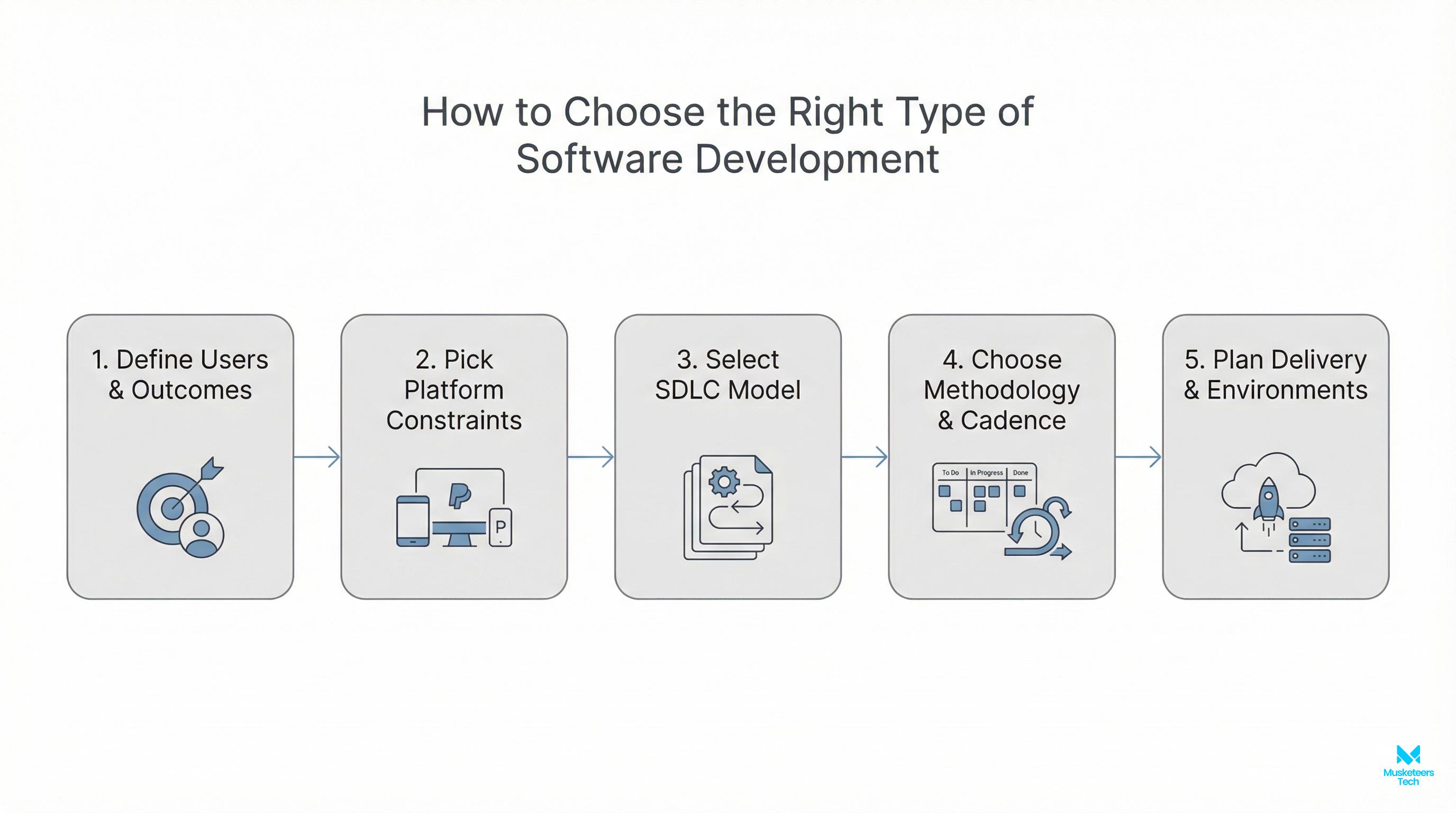
How to choose the right type for your project (selection matrix)
Here’s a fast, founder-friendly way to pick the best combination of project type + SDLC model + team delivery.
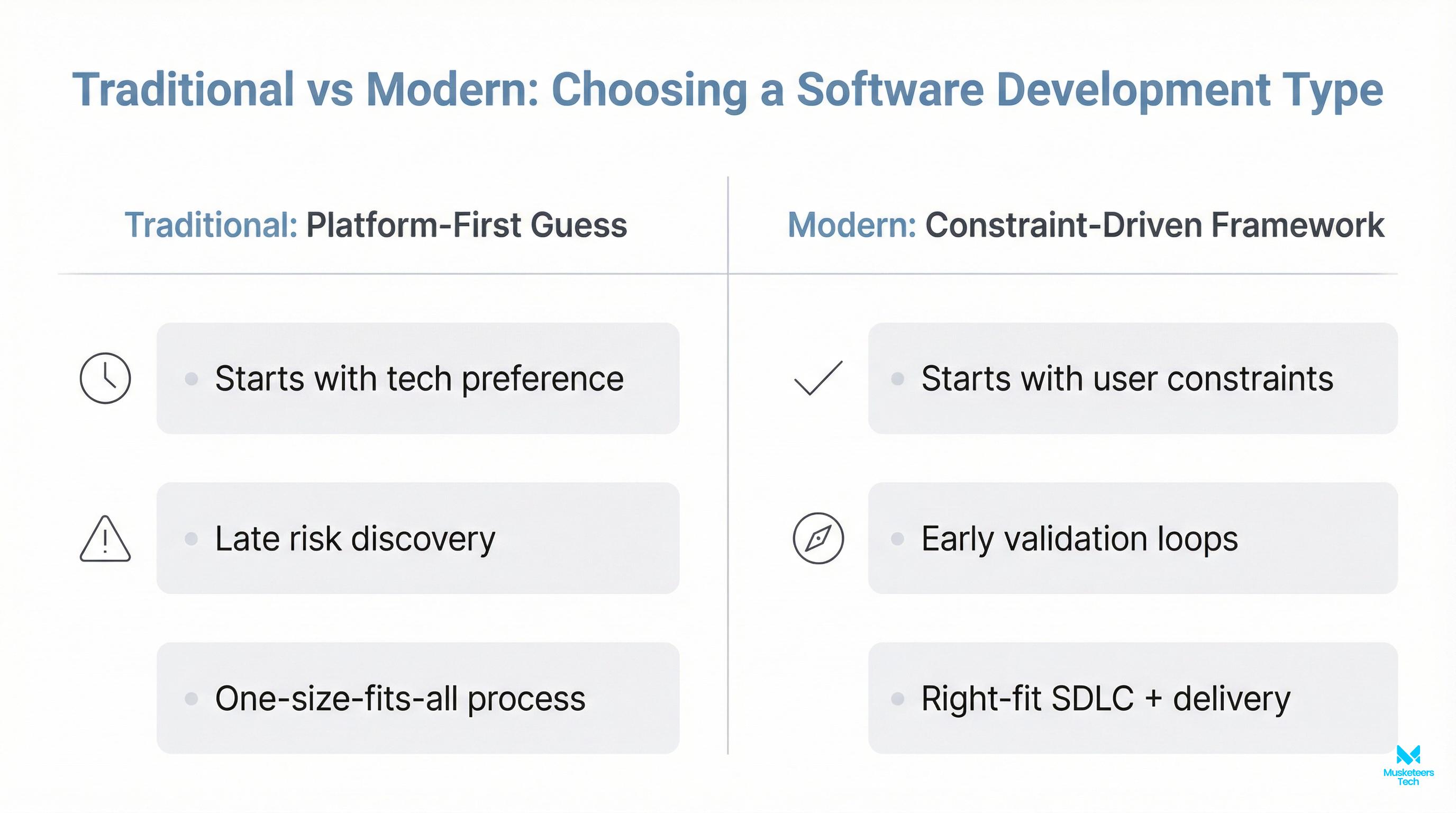
1) Start with constraints (not preferences)
- How stable are requirements? (Do you know what users want, or are you still validating?)
- How expensive is change? (Compliance, hardware dependencies, safety concerns)
- How often do you need releases? (weekly, daily, quarterly)
- What’s your risk profile? (security, uptime, data sensitivity)
- What’s the team maturity? (experience with Agile/DevOps, code ownership, testing habits)
2) Pick a “default” method and a risk-control layer
- If requirements are unclear: Agile + prototyping.
- If requirements are stable and audited: Waterfall/V-Model.
- If releases are frequent and reliability matters: Agile + DevOps (CI/CD + observability).
- If complexity/risk is high: Spiral (risk analysis baked in).
3) Decide the delivery model (in-house vs partner)
If speed and access to specialized skills are priorities (e.g., cloud, AI, mobile), co-development or nearshore teams can reduce time-to-hire.
Related reading:
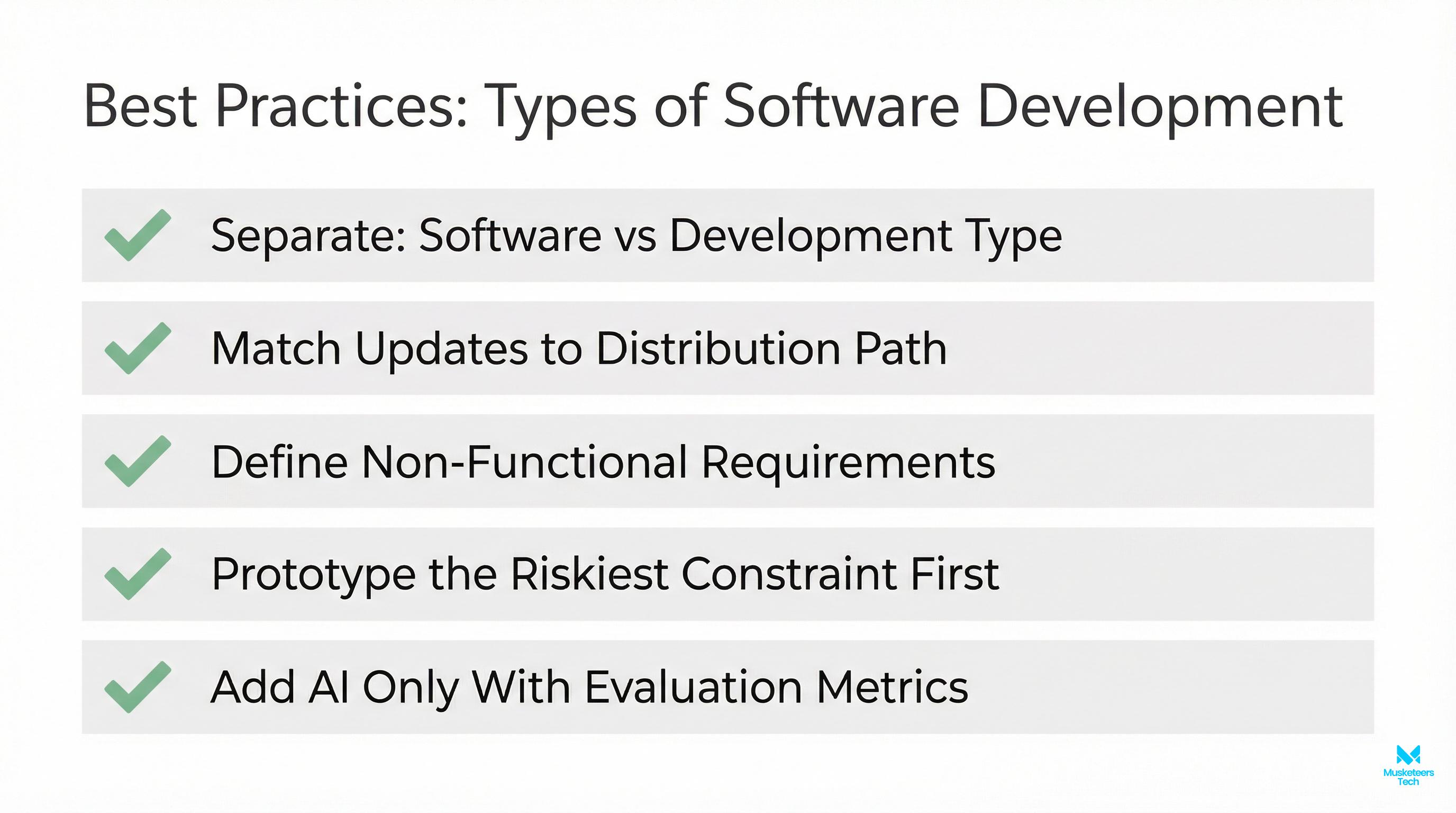
Best practices (and common mistakes) in software development
Best practices that consistently reduce cost and risk
- Define “done” with quality gates: include code review, automated tests, and security checks before merge.
- Design APIs and data early: late data-model changes cause the most painful rework.
- Use CI/CD even for MVPs: a basic pipeline pays off in fewer regressions and faster releases.
- Track product outcomes, not just output: connect engineering work to KPIs (activation, retention, support deflection, revenue).
- Document the essentials: “Agile ≠ no documentation.” Keep lightweight decision logs, architecture notes, and runbooks.
Common mistakes to avoid
- Mistaking “types of software development” for “types of SDLC models.” You need both dimensions.
- Choosing Waterfall because stakeholders want predictability (then changing requirements weekly).
- Skipping QA because “we’re moving fast.” This creates compounding delays later.
- Ignoring operations (no monitoring/alerts/logging) until after launch.
- Letting AI write code without guardrails. Use tests, review, and secure defaults.
Tools & platforms teams use in 2026 (practical stack)
Tooling evolves, but the categories stay stable:
- Planning & delivery: Jira / Linear / Azure DevOps
- Design: Figma + design systems
- Code + collaboration: GitHub/GitLab, protected branches, code owners
- CI/CD: GitHub Actions, GitLab CI, CircleCI
- Testing: Playwright/Cypress (web), XCTest/Espresso (mobile), Postman/Newman (APIs)
- Observability: OpenTelemetry, Datadog, Grafana, Sentry
- Cloud & infra: AWS/Azure/GCP + Infrastructure as Code
- AI-assisted development: code completion, test generation, code review assist (use with policy + security scanning)
For cloud-heavy products, DevOps and automation are no longer “nice to have.” Competitor data also highlights the scale of DevOps and Agile adoption trends (as discussed on Itransition’s page): Itransition — Methodologies
Image file suggestions (SEO-friendly)
- types-of-software-development-hero.webp
Alt: “Types of software development explained with SDLC models and project types”
Prompt: “Isometric tech team mapping software development types on a wall board, three lanes (project type, SDLC model, delivery model), professional office, high detail” - software-development-methodology-matrix.webp
Alt: “Waterfall vs Agile vs DevOps methodology selection matrix”
Prompt: “Minimalist decision matrix chart plotting Waterfall, Agile, DevOps, Spiral, RAD across axes stability vs speed, clean typography” - sdlc-7-stages-diagram.webp
Alt: “7 stages of the software development life cycle (SDLC) diagram”
Prompt: “Circular SDLC diagram with 7 labeled stages, modern flat design, neutral palette, easy-to-read labels”
Frequently Asked Questions (FAQs)
Types of software development commonly refer to:
- Project/platform categories (web, mobile, embedded, data/ML, etc.)
- Delivery approaches (Agile, Waterfall, DevOps, Spiral)
To choose correctly, first define what you’re building, then pick the SDLC model that matches your constraints.
How Musketeers Tech Can Help
If you’re still deciding which types of software development fit your product, we can help you turn that decision into an execution plan that ships reliably.
At Musketeers Tech, we support teams end-to-end—from selecting the right SDLC model (Agile, DevOps, or a hybrid) to building and scaling the actual product. For early-stage products, our MVP approach focuses on fast validation without sacrificing engineering fundamentals like CI/CD, testing, and secure-by-default architecture.
Explore our MVP Development Services for rapid builds, or our Software Strategy Consulting if you need help choosing the right platform, architecture, and delivery model.
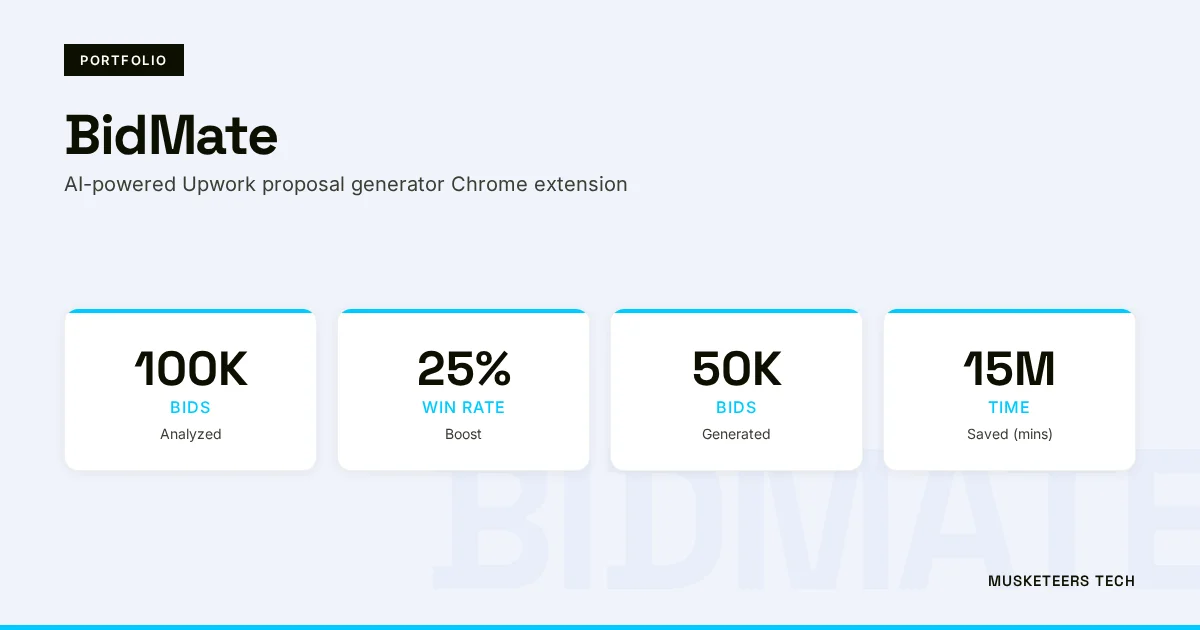
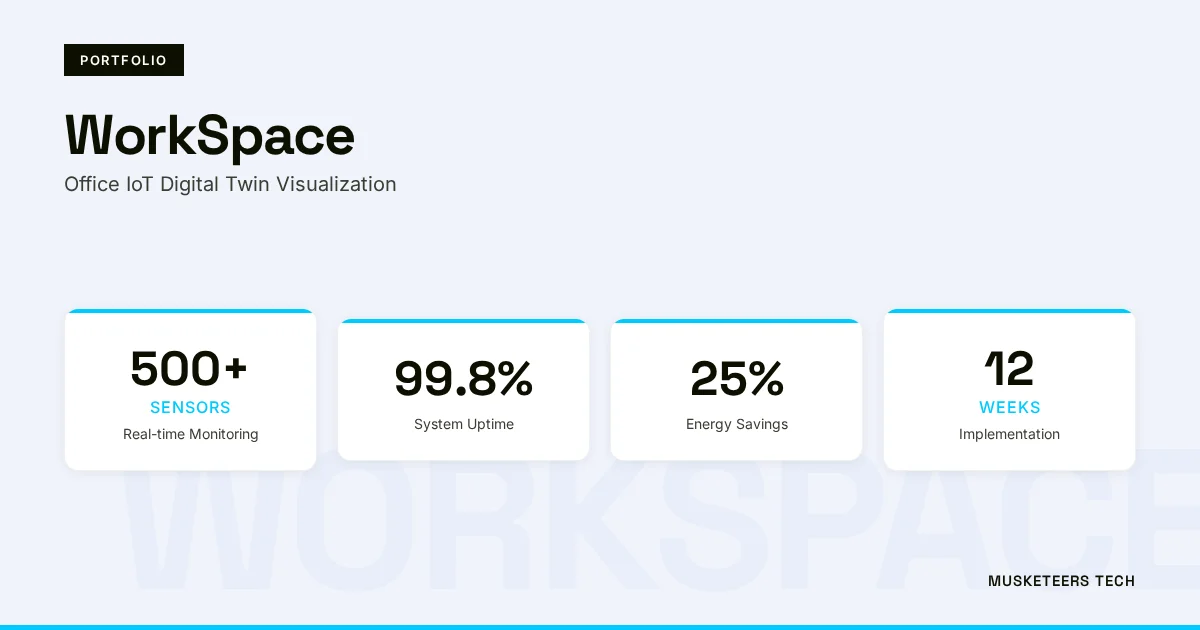
We’ve built AI-powered and immersive products across industries—see examples like BidMate (AI assistant product) and Workspace IoT Digital Twin in our work.
Learn more about our Web Application Development or see how we helped clients with similar challenges in our portfolio.
MVP Development
Validate fast with production-quality foundations (CI/CD, testing, secure defaults).
Software Strategy Consulting
Choose the right platform, architecture, and SDLC model with expert guidance.
Web App Development
Build scalable, reliable web products with modern stacks and DevOps.
Final Thoughts
“Types of software development” isn’t a single list—it’s a set of choices across project category, SDLC model, and delivery approach. If you separate those layers, decisions become much easier: pick the platform type based on constraints, choose the methodology based on how stable requirements are and how often you need to ship, and then align the team model to your speed and capability needs.
If you’re planning a new product, the safest default for most digital businesses is Agile + DevOps foundations (automated testing, CI/CD, monitoring) so you can learn fast while keeping releases stable. For regulated or high-risk environments, lean toward stronger governance models (Waterfall/V-Model or Spiral) while still modernizing tooling and quality gates.
Need help with software development planning or delivery? Check out our MVP development services or explore our recent projects.
Last updated: 04 Feb, 2026
