


Portfolio
FutureReady VR: STEM Robotics Simulation & Virtual Makerspace Platform
- Category:
Digital Transformation, Software Development, Product & Engineering
- Software:
Unity, Python Bridge, WebGL, ARKit, Physics Engine
- Service:
Metaverse & VR Development
- Client:
STEM Global
- Date:
December 6, 2025
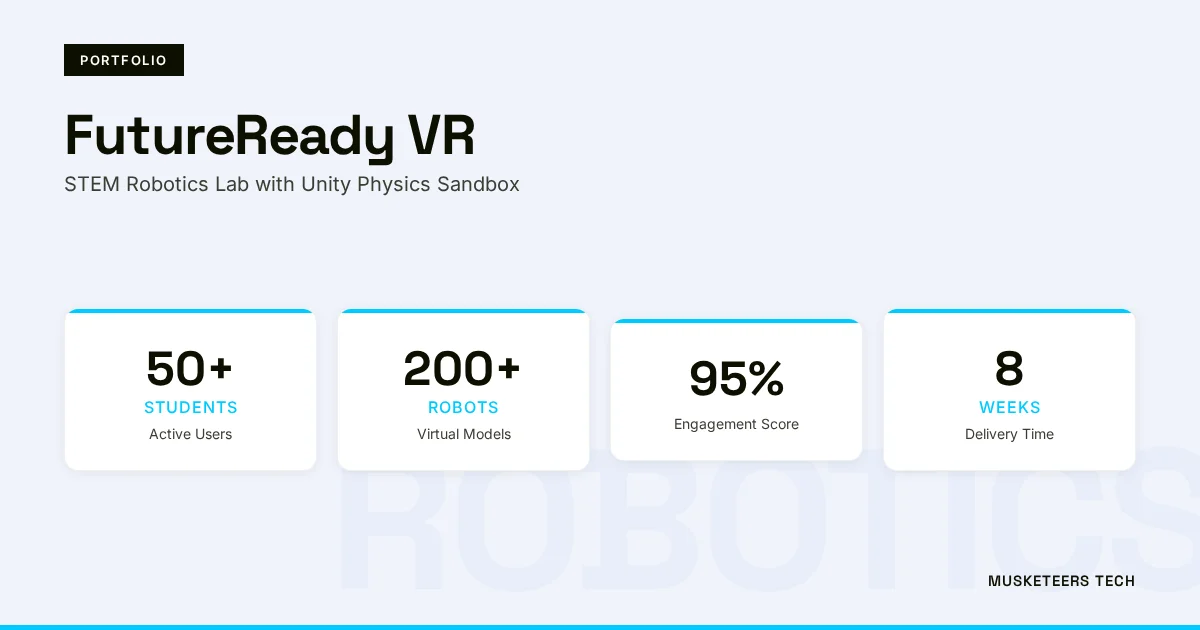
FutureReady VR is a virtual makerspace that democratizes access to expensive robotics hardware through high-fidelity robotics simulation — allowing students to design, build, program, and test robots in a Unity physics sandbox without physical components. Built by Musketeers Tech, the platform features VR hand-tracking assembly, a dual-mode coding interface (visual blocks and Python), and physics-accurate simulation arenas with motor torque curves, LiDAR sensor modeling, and multiplayer battle competitions. Students have designed over 1 million unique robots on the platform, and it hosted the first-ever National Virtual Robotics Championship with teams competing from all 50 states.
Infinite Parts Bin
In the real world, a burnt motor ends the lesson. In FutureReady VR, it’s a learning moment reset with a single click. The robotics simulation provides an infinite inventory of servos, sensors, wheels, and chassis components — encouraging boundless creativity and iterative engineering without the cost constraints that limit physical robotics programs.
Challenge & Solution
The Challenge: Robotics education is prohibitively expensive for most schools. Hardware kits cost thousands of dollars, rarely provide enough components for every student, and remote learning makes group hardware projects impossible. Furthermore, debugging code on physical robots is slow and frustrating for beginners — a wiring mistake or mechanical failure can consume an entire class period. STEM Global needed a robotics simulation platform that felt as satisfying as assembling real components, supported both beginner-friendly visual programming and advanced Python scripting, ran on school Chromebooks and tablets without installation, and provided physics-accurate simulation that validated real-world engineering principles.
The Solution: Musketeers Tech engineered FutureReady VR as a cross-platform engineering sandbox combining VR immersion with WebGL accessibility. In VR, students use natural hand tracking to snap motors, wheels, and sensors onto chassis using an intuitive magnetic snap system — building complex mechanisms through spatial interaction that develops genuine mechanical engineering intuition. The WebGL browser interface provides the same construction and programming capabilities on school Chromebooks and tablets, ensuring every student has access regardless of hardware availability. A dual-mode coding interface bridges the gap between beginners and advanced learners: Scratch-like visual blocks enable younger students to program robot logic (e.g., “If Obstacle < 10cm, Turn Left”), while advanced students inject raw Python scripts controlling virtual GPIO pins with real-time debugging and sensor data visualization. Once built and coded, robots enter physics simulation arenas using Unity’s rigid-body physics with accurate motor torque curves, friction modeling, gravity, and torque — students can test on “Mars Surface,” “Maze Run,” or “Sumo Battle” maps. This digital transformation of STEM education replaced expensive hardware constraints with unlimited virtual experimentation.
Spatial Engineering Construction
In VR, students use natural hand tracking to snap motors, wheels, sensors, and structural components onto a robot chassis. The intuitive magnetic snap system makes building complex mechanisms accessible to beginners while enabling advanced students to create sophisticated multi-joint assemblies. Students can paint, scale, and customize their creations instantly, developing spatial understanding of mechanical engineering through hands-on virtual construction.
Construction Capabilities:
- Natural hand tracking with magnetic snap assembly for intuitive robot construction in VR
- Zero cost per student eliminating the financial barrier to robotics education entirely
- Reduced setup and cleanup time allowing more instructional time per class session
- Spatial understanding of mechanical engineering through 3D manipulation of real components
- Instant undo/reset enabling fearless experimentation without consequences of physical breakage
Final Result
FutureReady VR has brought high-end robotics engineering curricula to schools with zero hardware budget, validating that physics-accurate robotics simulation provides genuine engineering education that transfers directly to real-world skills when students eventually work with physical components.
1M+ Robots Built
Students have designed and saved over 1 million unique robots on the platform, creating a massive library of user-generated engineering solutions and mechanical designs.
National Championship
Hosted the first-ever National Virtual Robotics Championship, with teams from all 50 states competing synchronously in cloud-based multiplayer simulation arenas.
100% Code Transfer
Code written in the robotics simulation is 100% compatible with popular physical education kits, enabling seamless transition from virtual learning to real hardware.
FutureReady VR demonstrates that the best robotics education starts in simulation — where every failure is a learning moment, every student has unlimited parts, and engineering creativity has no budget ceiling.
