
Portfolio
Rush Hour: Crowd Simulation & Evacuation Planning Platform
- Category:
Digital Transformation, Software Development, Product & Engineering
- Software:
Unity DOTS, Python AI, WebGL, GPU Instancing
- Service:
Metaverse & VR Development
- Client:
Metro Event Group
- Date:
December 6, 2025
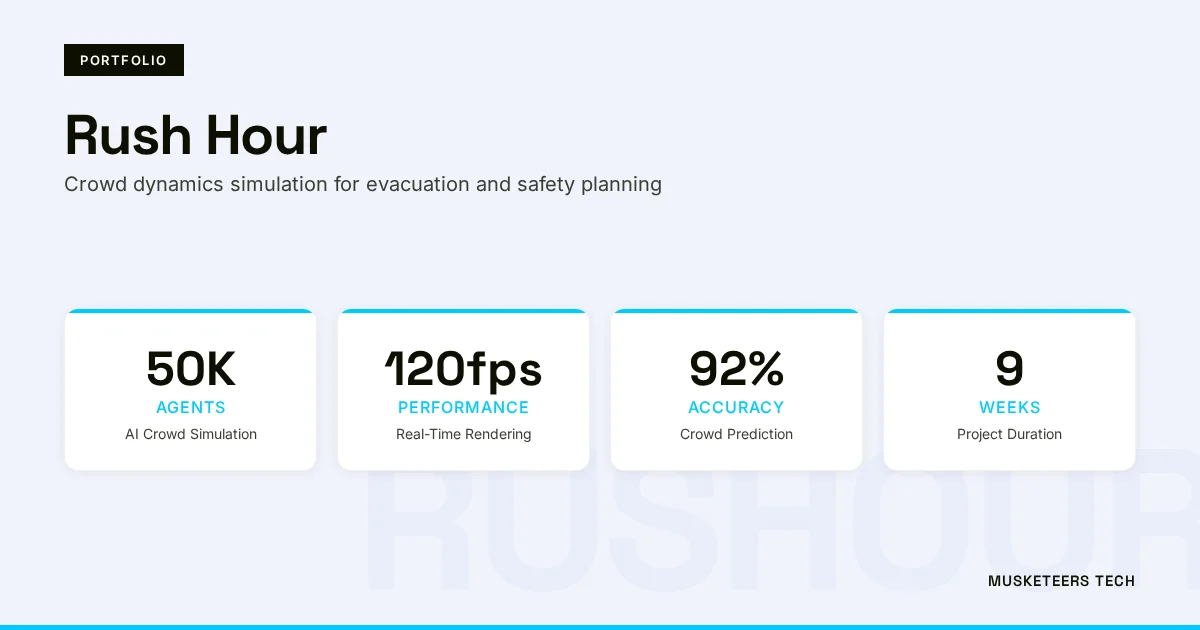
Rush Hour is an advanced crowd simulation platform that models the complex behavioral dynamics of human crowds at massive scale — simulating 50,000 individual AI agents with unique personality profiles navigating stadiums, malls, transit stations, and event venues. Built on Unity’s Data-Oriented Technology Stack (DOTS) by Musketeers Tech, the platform enables safety officers and event planners to test evacuation procedures, identify dangerous bottlenecks, and optimize pedestrian flow before a facility opens its doors. Venues optimized using Rush Hour’s crowd simulation achieved 30% improved ingress/egress flow rates during sold-out events, and the simulation data was accepted by local fire marshals as valid evidential support for new evacuation capacity ratings.
Predicting Human Chaos
Preventing crowd crush and stampede events requires predictive modeling that accounts for human irrationality — panic behavior, group clustering, distraction, and the counter-intuitive ways people move under stress. Rush Hour simulates these behaviors at scale, allowing safety professionals to test evacuation plans against realistic crowd dynamics before a single real person enters the venue.
Challenge & Solution
The Challenge: Managing large crowds involves complex variables that traditional flow diagrams cannot capture. Human behavior under pressure is irrational — panic triggers grouping behavior, distracted individuals create unpredictable obstacles, and perceived authority figures redirect flow in unplanned ways. Traditional crowd management approaches relied on static calculations (exits × width × flow rate) that failed to account for behavioral dynamics. Metro Event Group needed a crowd simulation platform that could model how 50,000 people would actually behave during a stadium emergency, how a Black Friday flash sale would impact mall corridors, and how a delayed train would cascade into platform overcrowding — with enough fidelity for the results to be accepted as safety evidence by regulatory authorities.
The Solution: Musketeers Tech engineered Rush Hour as a massive-scale agent-based crowd simulation using Unity DOTS for high-performance parallel processing. Each of the 50,000 simulated agents has a unique “Personality Profile” — Aggressive, Cautious, Group-Oriented, Distracted — that governs their navigation decisions, reaction speed, and social behavior. Using navigation meshes and local avoidance AI, agents naturally form lanes, clusters, and bottlenecks that realistically mimic real-world crowd dynamics. The WebGL viewer enables planners to upload CAD floorplans, run cloud-processed simulations, and watch resulting crowd flow in 3D on standard laptops — with drag-and-drop barrier placement, time-scrubbing playback, and exportable safety reports. A “Chaos Mode” stress-testing module lets users trigger random events — blocked exits, fire alarms, VIP arrivals — to validate contingency plans against unpredictable disruption. This digital transformation of venue safety planning replaced static calculations with behavioral simulation that accounts for the unpredictability that makes real crowd management dangerous.
Individual Psychology at Scale
Each agent in the crowd simulation has a unique Personality Profile governing navigation decisions, reaction times, and social behavior. Aggressive agents push through bottlenecks, Cautious agents seek alternative routes, Group-Oriented agents cluster with companions, and Distracted agents move unpredictably. This behavioral diversity produces emergent crowd dynamics that match real-world observation data.
Behavioral Metrics:
- Flow rate analysis measuring people per minute through each exit, corridor, and transition zone
- Density heatmaps identifying dangerous overcrowding zones that exceed safety thresholds
- Evacuation time analysis computing total clearance time under various scenario configurations
- Personality-driven navigation producing lane formation, clustering, and counter-flow naturally
- Panic cascade modeling showing how individual fear responses propagate through crowd sections
Final Result
Rush Hour has become an essential tool for safety certification at large venues, providing the behavioral simulation fidelity that regulatory authorities require for evacuation capacity ratings. The platform validated that agent-based crowd simulation with realistic behavioral profiles produces actionable safety insights that static calculations fundamentally cannot provide.
50K Agent Simulation
Successfully simulates 50,000 unique AI agents in real-time at 60 FPS, providing granular behavioral data on mass crowd movements and evacuation dynamics.
30% Improved Flow
Venues optimized using Rush Hour's crowd simulation achieved 30% faster ingress/egress speeds during sold-out events through data-driven layout optimization.
Fire Marshal Certified
The simulation data was accepted by local fire marshals as valid evidential support for new evacuation capacity ratings — a first for behavioral crowd modeling.
Rush Hour demonstrates that understanding crowd chaos is the first step to preventing it — and that behavioral crowd simulation at sufficient scale and fidelity provides the predictive safety intelligence that static planning methods cannot achieve.
